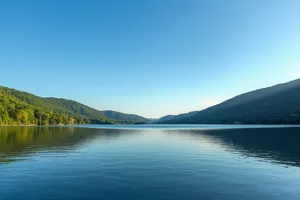
How Table Rock Lake Got It's Name and Why Battleship Rock Still Captures the Imagination
Names have a way of carrying history.
Sometimes a name tells you exactly what something is. Sometimes it points to something that used to be there. And sometimes, especially in the Ozarks, a name becomes part of the local memory long after the original story gets harder to prove.
Table Rock Lake is one of those names.
Most people know Table Rock Lake today as one of the great vacation lakes in Missouri. It is where families boat, fish, swim, cliff jump, watch sunsets, rent cabins, celebrate birthdays, and come back year after year because something about the Ozarks gets into them.
But the name came before the lake.
Before Table Rock Lake existed, there was the White River. And along that river, about a mile downstream from where Table Rock Dam would eventually be built, there was a rock shelf that stood high above the water. Missouri State Parks noted that Table Rock Lake received its name from that rock shelf, which stood above the White River before the modern lake was created.
That is a pretty perfect Ozarks story.
A rock formation gave its name to a lake that would later become one of the defining places in the region.
The lake itself was created in the late 1950s when Table Rock Dam was built on the White River for flood control and hydroelectric power. The U.S. Army Corps of Engineers built and operates the dam, and the lake became one of the major recreation anchors of southwest Missouri.
So in a way, Table Rock Lake is both old and new.
The name reaches back to the river, the bluff, the rock, and the people who knew the land before the water rose. But the lake as we know it today is the result of modern engineering, flood control, power generation, and decades of families discovering the water for themselves.
That combination is part of what makes Table Rock Lake so interesting.
It is not only a lake.
It is a place where geology, engineering, tourism, family memory, and Ozarks culture all overlap.
And then there is Battleship Rock.
If Table Rock is the name that tells us about the old river landscape, Battleship Rock is the name that captures the imagination today.
Anyone who has spent time on Table Rock Lake knows certain places become landmarks. They are not always official in the way a courthouse or a monument is official. They become official because people talk about them, point to them from boats, take pictures of them, jump from them, warn their kids about them, and tell stories about them later.
Battleship Rock is one of those places.
The name feels right even before anyone explains it. You see the cliff line, the shape, the way it rises from the lake, and the name makes sense. It sounds rugged. It sounds memorable. It sounds like something you would tell a friend to look for when they are out on the water.
That is the power of a landmark.
It does not need a sign to become part of the place.
For years, people have experienced Battleship Rock mostly from the lake. They boat past it. They photograph it. They know it as one of the dramatic pieces of shoreline that make Table Rock Lake feel different from a flat-water reservoir with no personality.
That is why Battleship Rock matters to us at Victory Springs.
We do not see it as a marketing phrase.
We see it as a part of local history.
When people search for Battleship Rock, they are usually not searching for a legal argument or a development debate. They are searching because they have heard of it, seen it, jumped from it, taken a picture of it, or want to understand why people care about it.
That care is real.
And honestly, it should be.
Places like Battleship Rock are part of what makes Table Rock Lake more than water surrounded by houses. The lake has character because of its cliffs, coves, bluffs, trees, rocks, bends, and old Ozarks names that sound like they came from people who noticed the land before they tried to improve it.
That is one of the reasons Victory Springs has taken this location seriously.
We are not building near an ordinary piece of ground.
We are working near a landmark connected to the way people experience Table Rock Lake. That creates a responsibility to think carefully about access, preservation, design, and the way future guests will understand the place.
The goal is not to erase the story and replace it with a brand.
The goal is to let the story become part of the experience.
A guest should be able to come to Victory Springs and feel that they are staying somewhere connected to the real Table Rock Lake, not a generic vacation development that could have been built anywhere.
That means the name Battleship Rock should be used with respect.
It means the land should be treated as part of the guest experience.
It means the trees, the rock, the water, the views, and the walk toward the lake all deserve more thought than a typical site plan might give them.
Because history is not always found in a museum.
Sometimes it is in a name.
Sometimes it is in the shape of a cliff.
Sometimes it is in the stories families keep telling after a day on the water.
Table Rock Lake got its name from a rock formation above the White River.
Battleship Rock got its place in the imagination because people kept noticing it.
Victory Springs is being built with the belief that both of those things still matter.
The lake has a name.
The rock has a memory.
And if we do this carefully, the next generation of families will not only read about those places.
They will experience them.