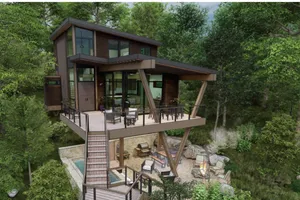
Why Couples Stays May Become One of the Strongest Categories in Hospitality
For a long time, vacation lodging was mostly built around function.
Where are we going to sleep?
How many beds do we need?
Is it close to the attraction?
Can the kids spread out?
Does it have a kitchen?
And honestly, there is absolutely nothing wrong with that. I’ve helped plenty of people buy and operate highly functional vacation rentals over the years. A condo in Branson can be a fantastic investment. A large family home with bunk rooms can perform incredibly well. Big group houses serve an important purpose in the short-term rental ecosystem.
But I think something deeper is happening in hospitality right now.
People are worn out.
Not “I need better sleep” worn out.
I mean, emotionally exhausted.
Every day feels like another wave of noise. Wars. Inflation. Economic uncertainty. Social media outrage. Political division. Constant notifications. Endless bad news cycles. Depending on which headline you accidentally click before coffee, apparently, aliens are now on the table, too.
At some point, people stop craving stimulation.
They start craving relief.
That shift is quietly reshaping travel behavior in ways I don’t think the broader hospitality industry fully appreciates yet.
Vacation is no longer simply recreation.
For many people, it has become recovery.
And I believe that is one of the biggest reasons couple-focused experiential stays are emerging as such a compelling hospitality category.
Because sometimes people do not need a giant house. They do not need ten bedrooms. They do not need a jam-packed itinerary where they come home needing another vacation from the vacation.
Sometimes what they actually need is one beautiful place, one incredibly comfortable bed, one peaceful firepit, one kayak launch, one quiet cup of coffee in the morning, and enough margin to reconnect with the person sitting across from them.
That may sound overly philosophical, but the travel industry is already seeing the same behavioral patterns.
According to Expedia’s 2025 Travel Trends Report, one of the dominant emerging behaviors is what they call “JOMO Travel,” or the Joy of Missing Out. Travelers are increasingly prioritizing quiet destinations, cabins, slower-paced environments, and experiences designed around decompression rather than nonstop activity. Expedia based its findings on first-party travel data and a survey of 25,000 travelers across multiple countries.
That aligns almost perfectly with what many experienced short-term rental operators have been observing in real time.
Travel itself is not slowing down.
People are simply becoming more selective and intentional about how they travel.
American Express Travel’s 2025 Global Travel Trends Report found that Millennials and Gen Z travelers continue prioritizing meaningful trips and emotionally rewarding experiences despite broader economic concerns. In other words, consumers may pull back in certain areas of spending, but travel continues holding emotional priority in their lives.
And honestly, that makes perfect sense.
The pandemic created a global case study that permanently altered human psychology around travel. For a period of time, the world collectively lost freedom of movement, and I do not think people forgot that feeling. If anything, it intensified the emotional value people now place on experiences, relationships, and intentional time away.
People may shorten trips.
They may drive instead of flying.
They may become smarter about budgets.
But I do not believe they are simply going to stop traveling.
What changes instead is where discretionary dollars get allocated.
And this is where couple-focused experiential hospitality becomes incredibly interesting.
Because if someone is already willing to spend $200 a night on a generic condo they barely remember afterward, it becomes surprisingly rational to spend slightly more for a place that feels unforgettable.
That is the lane I believe hospitality is moving toward.
Affordable luxury.
Not ultra-luxury excess.
Not fake luxury with gold faucets and uncomfortable furniture.
I mean emotionally intelligent hospitality. The kind of place where somebody walks in and immediately feels their shoulders relax. The kind of environment where the mattress is exceptional, the shower feels spa-like, the lighting is warm, the surroundings feel immersive, and every little detail quietly reinforces calm instead of chaos.
People willingly spend money on environments that help them feel better.
That principle becomes even more powerful in drive-to leisure markets like Branson and Table Rock Lake, where experiential travel continues outperforming many traditional lodging expectations.
Google’s 2025 Travel Trends data showed cabins ranking among the most searched lodging categories in the United States. Simultaneously, searches related to “travel hacks” reached record highs, suggesting travelers are still prioritizing vacations while becoming more strategic about how they spend.
That dynamic strongly favors thoughtfully designed couple stays.
A couple-focused unit does not necessarily need massive square footage. In many cases, smaller footprints create better emotional environments when they are designed intentionally. The value proposition is not based on sleeping capacity.
It is based on atmosphere.
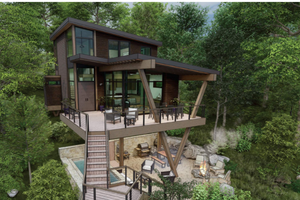
A deck in the trees.
A quiet soaking experience.
A firepit.
An outdoor shower.
A trail to the water.
A peaceful morning without interruption.
A place that feels emotionally distinct from normal life.
That is a completely different hospitality product than a standard condo.
One is functional.
The other becomes memorable.
And memorable hospitality tends to carry pricing power.
This also intersects naturally with the broader rise of wellness travel. According to TripIt’s 2025 Wellness Travel Report, 82% of travelers reported intentionally blending activity with downtime and restoration while traveling.
That trend feels deeply human to me.
People do not necessarily want to disappear into a silent spa retreat for a week pretending they have transcended modern life.
They also do not want nonstop stimulation anymore.
They want both.
Adventure and calm.
Experience and restoration.
Connection and privacy.
That balance is exactly where couple-focused experiential hospitality thrives.
And honestly, this is one of the reasons we are doubling down on this category at Victory Springs.
I’ve been watching patterns in this industry since 2006. Long before institutional capital fully understood short-term rentals, I saw the emotional shift happening in travel behavior. I watched travelers prioritize experience over standardization. I watched ordinary people willingly spend more money for places that felt unique, intentional, and emotionally rewarding.
This is another one of those patterns.
Victory Springs is not us inventing an idea and hoping the market responds.
This is product-market fit.
This is recognizing that people are already asking for more intentional hospitality experiences, more emotionally restorative travel, and more meaningful places to reconnect with the people they care about.
We are simply listening carefully enough to build what the market is already demanding.
And I believe the operators who recognize that shift early are going to define the next era of hospitality.
Curious where hospitality, experiential travel, and STR investing are heading next?
I spend time studying emerging trends, investor behavior, hospitality systems, and experiential real estate development.
If you would like to continue the conversation, you can schedule time with me directly.