What Makes a Vacation Rental Unforgettable?
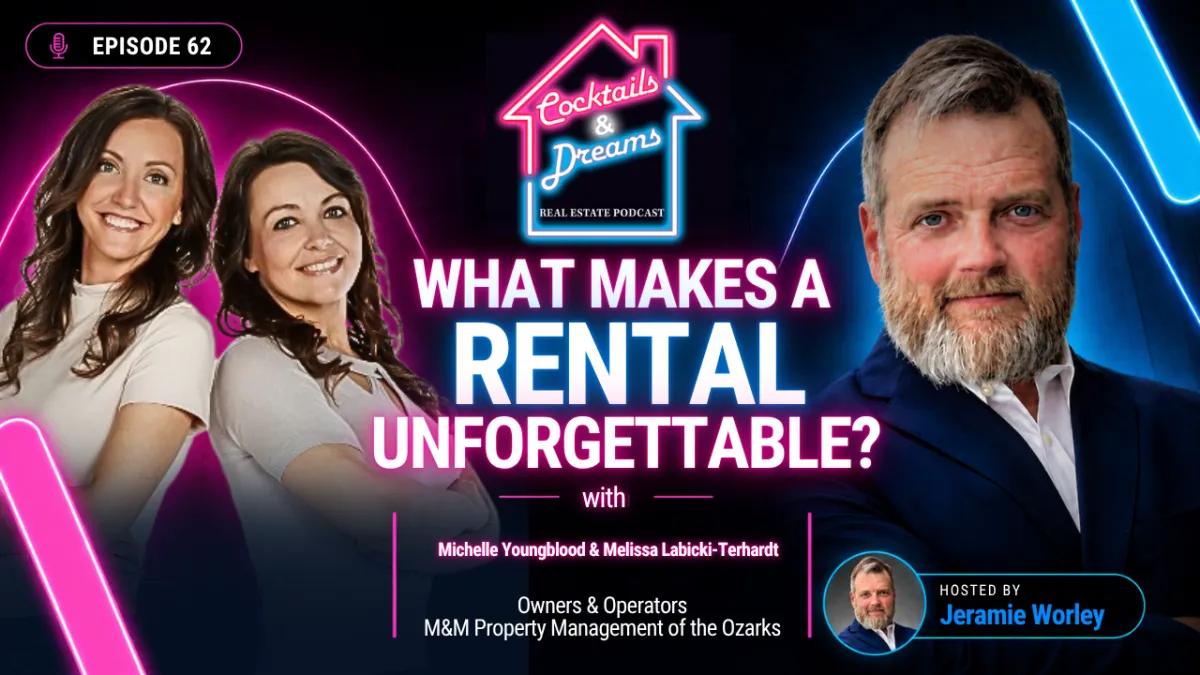
Cocktails & Dreams Real Estate Podcast with Jeramie Worley
Episode 62
Michelle Youngblood & Melissa “Missy” Labicki-Terhardt
M&M Property Management of the Ozarks
A clean property and a good location used to carry a short-term rental a long way. In today’s Branson market, Michelle Youngblood and Melissa “Missy” Labicki-Terhardt of M&M Property Management of the Ozarks say the standard is higher: guests expect thoughtful design, responsive communication, smooth operations, private amenities, and a stay that continues the vacation experience after they walk back through the door.
In Episode 62 of Cocktails & Dreams Real Estate Podcast, Jeramie Worley sits down with the sisters behind M&M to talk about what great property management actually looks like behind the scenes. They get into owner expectations, pricing and occupancy, guest relationships, maintenance, check-in systems, the growing importance of experience, and the operating standards they believe make a property memorable. The conversation also connects those lessons to the guest-experience philosophy Victory Springs is developing.
Links
https://mmozarkproperties.com/
https://www.victorysprings.com
https://www.facebook.com/VictorySpringsTRL
WATCH THE FULL EPISODE
Editor's note: This transcript has been lightly edited for readability, punctuation, obvious speech-to-text errors, and proper names. The substance and conversational tone of the interview have been preserved.
From Family, Corporate Life, and Cleaning to Property Management
Jeramie Worley: Hey, we're just doing a kind of a quick conversation with Missy and Michelle and we're talking about property management for short-term rentals in Branson, Missouri. I've got a couple of great experts here who have been running their business for a couple of years. So it's really great to be with you guys today. So Michelle, talk to me a little bit about why you guys decided to get into property management at Branson.
Missy Labicki-Terhardt: Sure.
Michelle Youngblood: So for me specifically, starting in property management came after many years in the corporate insurance industry. I'd worked for a large company for over 15 years and I really struggled with the 8 to 5 clock in. So I worked 40 hours a week and really juggled with my personal life at home as well with my children. And so opening up a company and working 80 hours a week seemed a little bit crazy. But also it gave me the flexibility to work in the hours and still find a great balance. And property management has always been Something that's interest. Interested my family, we have a small family resort out on Indian Point and really loved it. Having relationships with the guests that would come in and out and just establishing a fun resort out there.
Jeramie Worley: So how about you, Missy?
Jeramie Worley: Just without overthinking it, Missy: why did you jump into business with your sister?
Melissa “Missy” Labicki-Terhardt: I jumped into business with my sister because I had dabbled industry for quite a few years.
Jeramie Worley: Okay.
Melissa “Missy” Labicki-Terhardt: And our family had. One of my immediate family members had an accident. And that accident changed the trajectory of how our household was run. And I decided I needed to jump all in and do something. And so I was really passionate about this industry. I love the idea that I'm able to help families create lasting memories. And we had our own rental properties, so I knew there was a need for this.
Jeramie Worley: Necessity is the mother of invention sometimes, I would say. And I think that's actually a really good story because it speaks to how relentless that you can be when you need to because kids still need food on the table and somebody still has to operate. And there's actually a real need in this area for good property management companies. When I first started as a Realtor over almost 20 years ago, there was 800 realtors in the marketplace. And I asked myself, I was like, why does Branson need another realtor? And it was because the ones that were there, only a few of them were doing a really good job. Nobody was picking up their phone on a Saturday. Nobody was returning calls the same day.
Jeramie Worley: So I thought, those are the two things that I'm going to do as a real estate agent when I'm starting my business. The two things that I. Two standards that I know that I will never violate are I can answer my clients' calls by the end of the day. If you call me, I'm going to call you back the same day.
Melissa “Missy” Labicki-Terhardt: Whoa.
Jeramie Worley: Who knew that was wow factor, right? And then also I would call people on a Saturday. I would pick up my phone on a Saturday. Because early in your career, when you're a real estate agent, like you said, Michelle, earlier on, you know, as a business owner, you got tired of clocking in and doing the nine to five, but now you're doing the nine to nine, because no one's going to hassle you for bringing your kid to work with you, because you have to. It's not balance anymore, really. You said balance, but I'm going to challenge you on that because it's not balance, it's just more integration. And that can be good, you know, but it could also be bad because sometimes you feel like you're always on. But I would say that in this business, you're.
Jeramie Worley: You're kind of always on anyway because the, you know, Robert Kiyosaki, the guy who wrote Rich Dad Poor Dad, he's a big real estate investor and he's like, buying the real estate is the easy part. It's the managing of it that's the hard part. So one of the things that I really love about you guys and your business is that you're incredibly organized. You definitely see needs in the marketplace and you fill those needs. And you do that because you're operators. So when I think about you guys, I think about the book, the The E-Myth. Have you guys ever read that book?
Michelle Youngblood: No.
Jeramie Worley: The The E-Myth is a phenomenal book. And in that book, there's three main archetypes that you would have to have in your business in order to succeed. One of them is a visionary. One of them is a manager, and the other one is a technician. And you guys are incredible managers. And Michelle, I've known you for a number of years, and I would say one of the reasons why you really, truly succeeded and were extremely sought after in that leadership role with the insurance company is because you had your stuff together. You, you still do. I know you and your life and I know all of the things that you manage. And you manage a lot. And I think that's what makes you super successful at this business as well. And it makes me want to be in business with you guys as well.
Jeramie Worley: Because I am not a manager. I can be a manager, but I am not a manager. I am a visionary trapped in a manager's body. And when I'm a technician, when I have to go show property or sell real estate or pick up the phone and make a sales call, I'm the most frustrated. Right? I can manage a lot just because the buck stops here with me a lot of the times. But when it comes to where I'm, do I really soar? It's the visionary role. So would you guys agree with that? Would you call yourselves managers?
Michelle Youngblood: Absolutely. We're moms first, manager second. So I think you nailed it when you said how we are able to integrate our family life with our business. I mean, my son is our tech support at our company. So having a small family run company, it's like we really do get all of our kids involved. And it's been a great experience for us to be able to do that.
Jeramie Worley: It's good for kids to get involved like that. The education that they're getting, they would not get if you were working that 9 to 5 job, you know, so it can also go the other way too, because sometimes my kids are like, I'll never get into real estate because they saw how stressed out mom and dad can be from time to time. But sometimes, you know, hey, they'll get out there and they'll enter the job market and they'll realize that it's a much higher dollar per hour if you do what mom and dad did. But praise God, I hope that they become doctors and lawyers and engineers because it'd be way better than, you know, the pathway that we chose. But.
Jeramie Worley: But I chose it for the same reasons that you guys did was because I had an 8 month old baby when I started and my wife was the steady Freddie. She was the one that took the retail job in the beginning while I went out and worked the commission only job and figured everything out in real estate. So it takes a couple of people like you and when I. I've met a lot of property managers in my time and you guys are extremely organized and the projects that you take on are incredible. And what you have done has really, I think, created a positive ripple in the marketplace. And that's why we're talking about you guys coming on to help us manage our property at Victory Springs because your standards are very high. So let's get into it a little bit.
What Great Property Management Actually Requires
Jeramie Worley: A lot of people, especially property owners, think that property management is just mostly about cleaning and answering guest messages. But what do you think people misunderstand about what great management really is?
Michelle Youngblood: I think effective management really boils down to being proactive problem solvers. It really comes down to having conversations with owners before the guest even walks in on things that might need to happen to their home to make that experience when the guest comes.
Jeramie Worley: What do you think separates a property guests simply stay at from a property they remember, review, or come back to?
Michelle Youngblood: I think design matters more now than it ever has before. Neutral is just too safe anymore. And so I think you really need a property that has unique decor. You have to spend some time and to detail. But ultimately, I think what it really boils down to is having prompt communication with the guest that really makes that stay memorable.

Jeramie Worley: Got it. Anything else you think makes it that memorable? What are some things you guys have done that help people remember where they stayed?
Michelle Youngblood: I think five years ago, just you could have a clean condo with a great lake view and that would keep your calendar very booked through Memorial Day to Labor Day. And over the last five years, things have really shifted in our market. So just because somebody pulls in the driveway and they're back at their Airbnb for the night, they're no longer looking just to go to bed. They're looking for that experience that they had from the day to continue. So maybe they've been out on the lake all day, they want to come back to their cabin. They don't necessarily want to go straight to bed. They're looking for the hot tub, the sauna, the pickleball, Pac man games, things to keep the kids busy. They're really looking for that experience to happen and that vacation to continue through the length of their stay.
Jeramie Worley: So the private amenities, or do you think amenities just available amenities in a community, or do you think the private amenities are a special thing?
Michelle Youngblood: Private amenities are definitely a special thing, especially a private pool, private sauna. Hot tubs used to be more of a luxury item, but they're becoming more basic. It's kind of more the standard now to have a hot tub if you have a private standalone unit. I do think being able to offer indoor pool at a resort is also a great feature during those off season months when an outdoor pool may be closed. But I definitely feel like people really enjoy privacy more than ever. And so I do think having the private amenities is more valuable these days.
Jeramie Worley: I agree 100%. And that's another reason why we've really wanted to put some of the, some of those experiential things with our glamping units there. I mean, your husband Brad is my business partner. And you know, a lot of the things that we're putting into Victory Springs, they're not just great ideas. They're actually tested on some of the properties that you guys own and that you guys manage. And it's those private amenities that people remember, like sitting in a hot tub and watching a movie. You know, I mean, you're not going to do that in your own home. And that's one of the things that I think we're really trying to push at Victory Springs is what are those things that you're willing to rent that you wouldn't actually go buy?
Jeramie Worley: You know, somebody may not go buy a Jeep Wrangler because it's just not practical for their family, but when they go on vacation, they're going to spend more than you normally would to rent a Jeep Wrangler because it's fun, it's exciting. You feel like you're free, you've got no windows, you're just driving, you're living that life that you've always sort of wanted to live, but it just doesn't make sense for you to allocate the funds for that when you've got college to pay for kids at this point in time, and I was talking to my wife about this a little bit and it's the same thing as I'm not going to go buy a $300 bottle of whistle Pig whiskey because I just don't want a $300 bottle of Whistle Pig whiskey, but I'll go spend $22 a shot to try it once.
Jeramie Worley: You know what I mean? It's the exact same kind of thing. So you guys have, you actually have great data on it that you've shared with us. And I just think that it's pretty, pretty cool. So let me ask you this question. How do you balance owner expectations with guest expectations when those two things maybe don't always line up?
Owner Expectations, Pricing, and Data
Melissa “Missy” Labicki-Terhardt: I think open communication is key on that to manage those expectations.
Jeramie Worley: So have you been in a situation where your expectations and an owner's expectations have been different or do you feel like you try to wrangle all that in the very beginning?
Melissa “Missy” Labicki-Terhardt: We usually try to wrangle that all in the beginning. With the first meet, we'll usually walk through a property and let them know what we think that the property needs to be successful. But we have had owners that sometimes don't think that's a necessity. And those might be properties that we might not consider taking at that time because we really do feel that if you don't make those changes right up front, it'll affect the trajectory of how your bookings will go.
Jeramie Worley: I agree. It's so important to be honest up front and manage expectations and maybe not do business with somebody because ultimately it's the same thing. I would always coach real estate agents as, you know, maybe you don't want to take the listing if your owner's expectations of sale price are way higher than what the market will actually bear, because ultimately you're going to be the one responsible for not selling it. So if the property isn't booking out as much as the owner wants and you're like, man, I told you from the very beginning that you've got to do this or you've got to change this, they're actually making it harder on you when you kind of run your business. So let me ask you this.
Jeramie Worley: When you take over a property, what are the first things that you kind of look at to know whether or not it's being managed poorly or whether it was managed well?
Melissa “Missy” Labicki-Terhardt: I like to look at the maintenance of the home or the property first to tell if it's been kept up. And then the other thing would be the guest reviews. I like to look at the guest reviews and see if there's, you know, recurring themes as for different maintenance or other issues that guests might be putting on there repeatedly that have not been taken care of. Another thing we look through is the occupancy and the rates. Got it.
Jeramie Worley: So what are you looking for when you're looking at occupancy and rates?
Melissa “Missy” Labicki-Terhardt: Maybe their occupancy level is high, but the rates have been too low. And that may be why they're dissatisfied. And that might be why they're calling us to come take a look at their property.
Jeramie Worley: So you guys can go in and do some mathematical surgery on the property and be like, whoa, you know, we're really booking this thing up a whole lot. We need to kind of increase our. Our rates here to earn more income for the property owner. So is that a system that you guys have? Is it proprietary? Or what are you kind of looking for without sharing too much and giving away all your cool trade secrets? What are you looking for there without oversharing?
Michelle Youngblood: It's really just data analysis that we go into. So we'll look at other properties in the area, and chances are we're really familiar with the area and we're familiar with the property already. And if we're not, we probably have a nearby one that we're able to.
Melissa “Missy” Labicki-Terhardt: To use.
Michelle Youngblood: So it's just some information that we'll use to help create what we think the nightly rate should be. And also with having a high occupancy, if that was the owner's concern, is that it's rented too often for too low. Oftentimes they have a minimum threshold that they say, I really don't want it to ever go below this amount, and I would rather it be unrented because then my electric bill is higher, the wear and tear is higher, and all of those things add up. And it's just about really listening to the owner and their expectations and their wishes and still being the expert in the industry and knowing what that home can provide and what kind of numbers that it can handle.
Jeramie Worley: I think an owner's business model is a little bit different than a property manager's business model, and I think they should be the same, which is why I think what we're going to be doing at Victory Springs is going to be important, because even this Is my opinion. You can tell me if I'm wrong or not. But when you rent a property to a guest, that guest becomes, or we hope that guest becomes a contact for life. And when I wrote the second edition of my book Mismanagement and Mastery of short-term Rentals, I did a new kind of forward for my book. And I originally wrote my book in 2016, but the market completely changed in 2022 when I wrote my second edition.
Jeramie Worley: And there was a lot of things that we didn't have to worry about early in the business that we do now. Regulations was one of them. When we first started in this business, there was no inventory. So we kind of wrote the book on new construction and selling new construction out there in the marketplace. And so we had to manage expectations of a lot of different people kind of, you know, in moving that direction. So everything has changed. You're right. And would you guys say that when you take over a property, are you taking over a property that was typically managed by the owner or managed by another property management company?
Melissa “Missy” Labicki-Terhardt: Both.
Michelle Youngblood: Both. About 50 are self-managed, and then some are coming from other companies as well.
Why Self-Management Gets Hard Fast
Jeramie Worley: Okay. So you're dealing with people who may be frustrated because they're done renting it themselves, or they don't have time to learn the expertise of the market. When you're taking over a property from an owner, what are the reasons why?
Michelle Youngblood: A lot of the complaints would be about timing. I don't think they realize how much time it really takes to manage a property, even if it's just one property. You can get calls at any time of day and that guest wants things fixed right away. And so that seems to be an issue as well as maybe just not knowing the market and not knowing what it takes to really amplify your listing. So usually they call in frustration looking for help and assistance. They also may not have the team, so maybe they had an electrician that they found on Facebook and they did more damage than good when they came. And so they realize when there's an emergency that comes up.
Michelle Youngblood: I don't even have a team of people to really help me with plumbing or HVAC or my cleaner missed a clean and I have nobody else to contact. So I think all of those things really play into self managing, especially if you're not right in the area and you can't keep eyes on your property.
Jeramie Worley: That's true. That also kind of speaks to one of themes that I've been talking about in this business is that a lot of people rushed into the short-term rental business because for a while there it was the only way for the average Joe to come in and start a high-cash-flow business without really having to know how to manage anything. Because you already know how to go on vacation, you know what you expect when you go on vacation and you know what your standards are. And so as long as you can provide that or as long as somebody in your household can provide a level of customer service that makes people say, wow, this person actually responds to me. They care about whether I'm having a good time or not. It's not.
Jeramie Worley: You don't have to go to college to know how to treat people. You know what I mean? And property management, a lot is about knowing how to treat people. Most in my opinion is my thesis is that people came into this business because they thought they could make a lot of money and you can. But they didn't realize that they would have to be in the hospitality business. They didn't realize they would have to be an expert marketer. They didn't realize that they would have to go out and build their power team of electricians and, you know, carpet, you know, people and appliance repair people and all of that, handyman and all of that. And I think having an organization or a company that does have that power team is incredibly essential. So we talked about owners a lot.
From Transactional Stays to Human Hospitality
Jeramie Worley: Let's talk about guests a little bit because you guys are also having to not only keep owners happy, but you're having to keep guests happy as well. So before we talk about guests, let me just talk about how the two kind of merge a little bit. So how do you balance owner expectations with guest expectations when those things don't always line up?
Michelle Youngblood: Again, I'm just thinking that how important open communication is, I think it's really important to constantly check-in with your guest, you know, not every day, but just to let them know you're available if something comes up, especially after check-in, just to make sure everything has gone smoothly and they're enjoying their stay. If there's anything you can do to help them. And same thing with owners. I think a lot of the owners who call us that have maybe frustrated with a property manager they're using currently. It all boils down to communication. And sometimes just a simple conversation would have cleared things up and changed the entire course of whether they were going to be able to keep them as an owner or not.
Michelle Youngblood: And so I think it just takes talking to people, whether that be the guests or the owners, and keeping that all aligned.
Jeramie Worley: Good.
Melissa “Missy” Labicki-Terhardt: It's all communication.
Jeramie Worley: Yeah, I think that's key in any relationship, whether it's business or personal. I mean, communication is absolutely huge, for sure. So I'm glad that's at the top of your list there. What about reviews? I know that reviews are important and we've always said that. And, you know, especially now that it seems like companies like Airbnb and Vrbo, in the very beginning, when these companies were mom and pop owned before they were bought out by, you know, big venture capital funded companies or companies like Expedia, you know those. I think those companies responded to human nature, which is, okay, I put my property on Airbnb, we've connected. Why do we need to pay Airbnb all these fees? Now that we can talk to each other, let's go do a deal. Outside of that, it's really hard to manage people's ethics and you can't.
Jeramie Worley: And it's really hard to manage people individually with different levels of ethics. So a big company with, that's a huge platform with millions of owners has to make blanket policy changes, like, okay, now you have to communicate with your guests through our app. You can't have their phone number, you can't get them. And like the industry itself succeeds best when the property manager or the owner can actually build that relationship and communicate with the guests. So how do you do it now that some of these platforms have taken that away from us?
Michelle Youngblood: I think having all these platforms have made everything very transactional. The guest pays, they get a code, they check-in, they check-out, they leave a four- or five-star review and say, thanks, great stay. And so I think there are so many ways to build a relationship with a guest throughout their stay. Even if they did book on platform, we're constantly on properties. If they'll see us in the resort in our T shirt and our matching cars all the time and stop us and wave us down. And I think it's all about just being present. Obviously you're not interrupting their stay or anything, but maybe if we had to clean a hot tub or something during their stay or help them with something, it's about being available so not just handling a remote question over the phone.

Michelle Youngblood: If I'm in the area and someone's really struggling, I'll say, hey, I'm five minutes away, can I swing by and help you with that? And I think it's about taking that piece, that transactional piece out of it and just making it. We're all human. We're all here to help their vacation. And I don't want them to think we're just a robot on the other side of the computer helping them walk through using a software. How to help them with a problem.
Jeramie Worley: Yeah, it's, it is about building a relationship and it's hard to do that when those companies do that. So I think that's a great answer. Like finding ways to at least give them the opportunity to interact with you if they want to. Right. So you don't want to be that creepy. I think about Robert De Niro and Cape Fear. You know, he just slow or like even. What about Bob? You know, he's just sort of there all the time and it's like, hey, you end up having dinner with these people. Like why is my property management? I think you can go too far with it. But you know, having that ability or something in the home for them to say, hey, this is how I interact with this person. Now let me ask you this question.
Jeramie Worley: Have you ever made yourself too available where people are now they're calling you all the time and have you ever had a guest that is just a little bit too needy and what do you do in that case?
Melissa “Missy” Labicki-Terhardt: We have had a few needy guests. Overall, I think we've handled it quite well. We're. I'm pretty much available anytime for any guest questions or to help them find the right property for their next day. Most of our guests will come back year after year. And so I think that's just part of it.
Check-In, Maintenance, and Operational Standards
Jeramie Worley: So is there any one operational detail that seems small but can really make or break a guest experience?
Melissa “Missy” Labicki-Terhardt: I think the check-in process matters. I think if it's smooth, hassle free, I think if a guest comes to the door and they can't get in and they can't get a hold of us to get in, I think your first impression really matters. So I think the systems that we have implemented with our management company have worked pretty smoothly and help us keep our guests happy.
Jeramie Worley: Cool. So what about property maintenance and things like that? Do you guys try to keep a proactive approach to property maintenance or do you just mainly respond to things? What are you looking for? Talk to me about your business a little bit.
Michelle Youngblood: In our contract with our owners, we definitely do some preventative maintenance. So that Includes having HVAC come out before the season even begins. Making sure that if it's something with Freon, the levels are good, everything's cleaned and ready. It's all about draining your hot water tanks, checking your elements. Where we are at, we just have some really hard water. And so it's really important that if there's not a water softener on the property already, that we are just being as proactive as possible. Because the last thing you want is a guest to go take a shower with cold water and call you, complaining when it was something very easy that we could have, you know, already addressed. So simple things like that, you know, clearing out the dryer vent, super important, huge fire hazard.
Michelle Youngblood: Takes a few minutes and just a phone call and scheduling to make that happen. So it's very important to keep your property top notch, not just for your guests, but even in the event that, you know, a few years down the road, you decide you want something different and you want to sell that investment, it's important that you've maintained it throughout that time and make sure that it's, you know, top notch for your inspection.
Jeramie Worley: So a good property manager could help you avoid those major maintenance items that would show up on a property like maintenance report or an inspection report from, you know, from your real estate sale. So I think that's a huge thing that you guys can do by having a property manager rather than owning it yourself. Like, if you're an absentee owner and you're trying to manage the property yourself, you're not going to see the things that you guys see.
Michelle Youngblood: Right.
Jeramie Worley: And what's interesting about you guys is that you're probably in the properties a lot. And Missy, I bet that your experience as a cleaning company gives you a much higher standard as a property manager because you've had that experience as well.
Melissa “Missy” Labicki-Terhardt: Yeah, I think I look at things a little differently when I walk through a property and I see things that the guests would not see. Hopefully we're preventing any issues that could arise with our inspections of all the properties.
Jeramie Worley: Yeah, a good cleaning team can let you know when you know that's cool quilt that you, as the owner selected for this bedroom, is missing. Or like for example, at the Chill Pickle, this nightly rental that Kelly and I have launched last year, she had just bought some new beach towels for the property. And when the cleaner came in, she said, hey, these new towels that you bought, half of them are missing. So she was able to just call the guests and be like, hey, I Think you might have accidentally packed these with everything else, and they're like, oh, you're right. Cool, we'll send you Venmo you 40 bucks or whatever for some new towels. And it was very easy. But if somebody's not there to keep tabs on the property a little bit, it's.
Jeramie Worley: Some things might go missing, whether intentional or not, but it's usually an accident. Because, you know, the Branson. The funny thing about Branson that people say is that when people come here on vacation, they take their brains and they put them out on the counter and they leave them at home. They take their credit cards and they put them in their wallet, you know, and then they come to Branson, which is how I was able to sell $300,000 properties tourists when they came, you know, in 2008, 2009, back when short-term rentals were sort of brand new and people were like, what is this? But, you know, the industry has definitely changed. And I think that you were talking, Michelle, about this industry now being more transactional.
The Mom-and-Pop Reality of Short-Term Rentals
Jeramie Worley: And I think that, that's tougher for all of us because now, correct me if I'm wrong, but a lot of people now treat us like the Hilton, and we're not. short-term rentals are incredibly different. It's mom and pop, it's me and Kelly that own it. It's you and Brad, It's. It's Missy and your husband. Right. And so you guys are the ones that are having to, you know, deal with that guest. And we don't have the resources of the Hilton. So when somebody cancels the day of and wants a full refund or Airbnb wants to give him a full refund, that's a huge, meaningful thing because we don't have millions of dollars in liquid reserves for capital expenditures, you know, for these kinds of things.
Jeramie Worley: Which is why Kelly and I have made a really strong push to rebrand our individual rentals, the ones in our personal portfolio, as classic vacation rentals to try to help people understand that when you're doing business at the Chill Pickle, you're doing business with Kelly, you know. And so do you feel like that's important?
Michelle Youngblood: Absolutely. I think it's becoming an issue more often than not where a guest decides last minute to cancel because something may have come up and they didn't purchase the third party insurance that's offered. And we'll often get the message from Airbnb or the call from Airbnb asking for the exception. And sometimes it's warranted and you feel led to allow that to happen and you just keep your fingers crossed and say a quick prayer and hope it rebooks. And sometimes we have to stick to it because we know it's not going to get rented for that time frame. And I do feel like guests should read through the cancellation policies and understand that we are running a business.
Michelle Youngblood: But on the other hand, you have to know that they might go to Google or they might go to Facebook or they might go somewhere else and leave this review that you were not willing to make an exception. And so I think it's just about finding a way to meet people in the middle. Like I said earlier, we're all human, we're all in this together. And so I think it's about just running it ethically and how would I want to be treated if I was in the situation. And that's, I think what has made us successful this whole time.
Jeramie Worley: I agree. Yep. I've always thought that people should get into this business because you know, why should Paris Hilton have all the money? But you know, it really is a great way, I think for the average Joe. I've never said that owning a short-term rental was easy. I've always said that it's the highest paid part time job that you'll ever have and there's enough money in this business to be able to hire a professional like yourself. So I think that when it comes to the third party insurance that you're talking about, I did talk to somebody actually in this market then and they were, this was a number of years ago.
Jeramie Worley: But rather than having the guest pay for a third party insurance policy, which is really hard by the way, to get that, to actually get that claim paid for, there's so many rules and hoops that somebody, I mean, give me a break, is 250 bucks. But what they did is they offered their own insurance. It was not third party insurance, it was insurance with the guest or with the owner. Did you want to pay an extra 200 bucks for an insurance policy so you could cancel right up into the day? And they actually made a lot of money doing that. So I think. What do you think about that? Do you think that's a good thing or have you guys experimented with that at all?
Michelle Youngblood: I'm not experimenting with that. I think that sounds like a great plan. Depending on what all the exclusions are and the cost of course, and how that looks to the owner receiving the payment at the end. Because at the end of the day. We have an obligation to our guests, but we have just as big of an obligation to our owners. So when somebody cancels, that impacts what that investment was going to look like for that reservation.
Standards That Don’t Move
Jeramie Worley: Might be hard to do as a property manager, but if you own your own properties, maybe that's something we can explore at Victory Springs. Because I think having those kinds of options would be cool. If we can manage all of that in house, I think it would be way easier. And let's talk about standards a little bit. Like what are one or two standards that you guys are just absolutely, without a doubt, unwilling to compromise on?
Michelle Youngblood: I would say our first thing is a walkthrough of the property. It's something we don't compromise on. It's either Melissa or myself or Sarah who will walk through a property before a guest comes. That's something we really are proud that we're able to say we can do. When we take on a property, we make sure it's in our area to make sure that we can get to it in a timely fashion. So if somebody's checking out at 10 that we're there before 4 o' clock to make sure that hot tub chemicals are perfect and the house is perfect before check-in, I think it's really important to have that second set of eyes on things before the guest comes.
Michelle Youngblood: And even prior to that, I think something that we are really specific on is when somebody calls us and they want us to take out, they want us to take on their property. I think oftentimes it's a new investment. They're very excited and they just want to get it online and get it going. And so we're. Our standard is it has to be ready to go live. I think oftentimes they say, let's just go. And we'll do the update later and we'll get that. That amenity later and we'll do that. But let's get the money rolling in. And I think the property needs to be ready to go your best foot forward before anything gets online for people to book. I think it's essential that happens.
Melissa “Missy” Labicki-Terhardt: The thought of updating later usually never happens. Once it's booked, it's booked the way it is. They don't bother to go back in and do those updates that could help increase revenue.

What Owners Should Ask Before Hiring a Property Manager
Jeramie Worley: Life happens while you're making other plans. Right. It's kind of one of those things. I can't tell you how many lots that I've sold to people who want to retire Someday here and then that just never happens. They end up just selling the lot because the best intentions usually end in a different story than you had imagined in your head. So. Well, let's wind down with maybe one good question for somebody who's listening to this and they're thinking about hiring a new property manager for their own particular rental. What advice would you give a short-term rental owner before they hire their first property manager?
Melissa “Missy” Labicki-Terhardt: Do you want to take that one?
Michelle Youngblood: I'd say ask. Ask what strategies they have. You can ask for references. You just really want to make sure that you're going to align with your goals, will align with their expectations. And also ask how often they're going to be in the property. At the end of the day, this is an investment property, so you want to make sure that it's kept up well. And if they live two states away, five states away, and they're just handling guest communications over the phone, that might not be what you're looking for. And as an investor, I think the one question you really should be asking yourself prior to even meeting with the property manager is what makes my property unforgettable?

Michelle Youngblood: Because I think that piece, before you even have started to meet with your property manager, will help that relationship really build and make sure everything's aligned correctly. I think if you're starting and you really don't have a full plan of what your property will look like, or you might not have numbers already established, I think that's a great time to start talking with the property manager. But prior to signing any contracts or anything else, I think it's important to have conversations and make sure that when you purchase a property, you have a good sense of what that property is going to make for you and make sure that return is what you expect. Oftentimes I do feel like people might purchase a property and they have a thought in their mind of what that property should make by the end of the year.
Michelle Youngblood: And when it doesn't, it just sets up for disappointment.
Jeramie Worley: Great advice. So you got to have great unforgettable properties, great communication and give them a reason to come back, even if it's for the way they were treated while they were there. You know, I used to say that cleanliness is wow factor. You know, cleanliness was its own wow factor. But I would say guest standards have completely changed now and that cleanliness is expected. And there's a certain level of standard that we used to think was extra that's now is standard. So now guest expectations are even more than they were. And I think you guys do a great job of meeting and exceeding those expectations. And thanks for sharing your wisdom with us today and look forward to working with you on Victory Springs.
Michelle Youngblood: Thanks for having us.
About M&M Property Management of the Ozarks
M&M Property Management of the Ozarks is a Branson-area vacation-rental and property-management company operated by sisters Michelle Youngblood and Melissa “Missy” Labicki-Terhardt. The company’s official site describes its focus on Table Rock Lake and Branson nightly rentals, full-service management, local knowledge, professional cleaning, maintenance coordination, marketing, guest support and owner service. Learn more at https://mmozarkproperties.com/.
About Victory Springs
Victory Springs is the hospitality-development project discussed in the episode, with a focus on creating a differentiated guest experience around Table Rock Lake. Learn more at https://www.victorysprings.com and https://www.facebook.com/VictorySpringsTRL.
Listen to Cocktails & Dreams
https://open.spotify.com/show/2oWeHLsHQVSJJjU9GtRBBK
https://podcasts.apple.com/us/podcast/cocktails-dreams-real-estate-podcast/id1632712936
About Cocktails & Dreams
Cocktails & Dreams Real Estate Podcast with Jeramie Worley features practical conversations about real estate, development, short-term rentals, hospitality, investing, entrepreneurship and the people building businesses around them.