The Vacation Begins When the Car Disappears
Most vacations begin behind a windshield.
There are miles to cover, directions to follow, fuel stops to negotiate, and a vehicle packed so tightly that opening the wrong door can release half the family’s belongings onto the pavement. By the time guests reach their destination, they may have spent hours watching the road, managing children, answering questions and waiting for the navigation system to announce one final turn.
Then they arrive at a place created to help them escape all of that, only to find themselves circling another parking lot.
They search for a building number, squeeze between vehicles, unload luggage beside an idling engine, and begin their retreat beneath the glare of headlights. The natural setting may be only a few yards away, but the first experience still feels organized around the automobile.
I have come to believe that a nature-oriented hospitality destination should create a clearer threshold between the road and the retreat.
There should be a moment when the keys are put away, the luggage is handed off, and the person who has been driving becomes a guest.
That moment may be one of the most overlooked parts of hospitality design.
Parking Is Necessary, but It Does Not Need to Become the View
Americans rely on vehicles to reach destinations such as Branson and Table Rock Lake. That is not going to change simply because a hospitality development wishes it away.
Parking must be convenient, secure, understandable, and large enough to function during busy arrival periods. Families travel with coolers, strollers, groceries, fishing equipment and more luggage than they expected to bring. Older guests and people with limited mobility need dependable access. Service teams, emergency personnel and maintenance crews must also be able to move through the property effectively.
The question is not whether Victory Springs will need parking.
The question is where the presence of the automobile should end, and the guest experience should begin.
At many traditional lodging properties, parking is distributed around the buildings because it appears convenient on a site plan. Every accommodation gets a nearby drive aisle, a row of spaces and a direct route for vehicles. That approach may shorten the distance between a car and a front door, but it also spreads pavement, headlights, door slams and vehicle movement across the entire property.
On wooded land, every additional road or parking area also competes with trees, terrain and the visual character guests came to experience.
The U.S. Environmental Protection Agency identifies roads and parking lots as impervious surfaces. Rainfall that would ordinarily soak into the ground instead travels across those surfaces, potentially collecting pollutants before reaching surrounding waterways. The EPA recommends evaluating development patterns partly by how much new impervious surface they create and how runoff will be managed.
That does not mean a parking lot is inherently irresponsible. It means parking should be treated as infrastructure requiring careful planning, not as leftover space between buildings.
A more concentrated parking strategy may allow a development to manage vehicle circulation, landscaping, drainage, lighting and stormwater controls in a more deliberate way. It can also help preserve larger areas where the sights and sounds of vehicles do not follow guests to every accommodation.
The parking still exists. It simply does not become the main character.
Arrival Should Feel Like a Threshold
There is a reason people remember arriving by boat, train, or mountain tram.
The transportation itself creates a transition. The traveler cannot remain entirely connected to the place they left because the method of arrival requires them to change pace and pay attention.
A guest shuttle can create a smaller version of that experience.
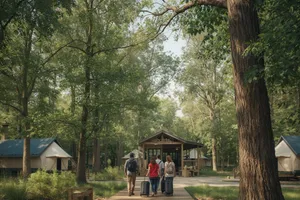
At Victory Springs, one of the concepts influencing the planning process is the possibility of separating portions of guest parking from the individual lodging areas. Guests could arrive at a clearly marked hospitality point, unload beneath a covered drop-off area, and continue toward their accommodation through low-speed guest transportation or pedestrian paths.
For the glamping areas, we have also explored the idea of creating rustic covered shuttle stops and broad boardwalk entrances that lead into the woods. From that central entrance, smaller boardwalks or paths could branch toward individual accommodations.
These ideas remain subject to design, engineering, and operational review, but the intention behind them is straightforward. Arrival should not feel like a logistical obstacle placed between the guest and the room. It should be the first chapter of the stay.
A well-designed shuttle ride through the woods should not feel like being transported across an inconvenient distance. It should feel as though the property has taken responsibility for the guest.
Someone else carries the luggage. Someone else knows the route. The family can stop watching for signs and begin looking at the trees, the lake, and the place they have come to experience.
The road has delivered them. Hospitality takes over from there.
Transportation Can Protect the Experience It Serves
The idea of separating vehicles from natural destinations is not new.
The National Park Service uses shuttles and managed parking in some of America’s most visited landscapes. These systems are not identical to a privately operated hospitality destination, but they demonstrate an important design principle: transportation can do more than move people. It can protect the experience people came to have.
At Bryce Canyon National Park, the shuttle is promoted as a predictable and convenient way to reach major overlooks and trails. The National Park Service says the system also helps reduce congestion, noise and air pollution within the park.
Muir Woods introduced parking reservations and expanded shuttle use after traffic congestion began creating parking problems and environmental pressure around the monument. The National Park Service reported that the changes reduced congestion, allowed visitors to spend less time competing for parking and produced a less stressful experience with less crowding in the woods.
At Reds Meadow and Devils Postpile National Monument, the shuttle system is used to reduce traffic on park and forest roads, protect sensitive resources from parking-related damage and reduce vehicle emissions.
Victory Springs is not a national park, and our guest transportation plan should not imitate one. The scale, expectations and operating responsibilities are different.
The underlying lesson is still useful. When transportation is planned carefully, it can improve access while reducing the extent to which vehicles dominate the destination.
For a Table Rock Lake hospitality development, that creates an opportunity to make arrival more peaceful, preserve the character of the land and give guests greater freedom to move through the property without continually negotiating traffic.
A Boardwalk Can Be More Than a Way to Get Somewhere
A path is often treated as the empty line connecting two important places.
I think the walk itself can become one of those places.
A raised boardwalk entering an Ozarks woodland changes how a guest encounters the property. It establishes a direction without requiring a large amount of paving. It can move carefully across changing terrain, protect sensitive ground in appropriate locations and create a clear route through the landscape.
More importantly, it slows the arrival just enough for the senses to catch up.
The sound beneath a guest’s feet changes. The parking area begins to disappear behind the trees. The air feels different beneath the canopy. The entrance ahead is no longer a numbered door beside a vehicle, but a path drawing the guest farther into the setting.
This does not require an elaborate theatrical performance. The landscape already provides most of what is needed.
The work of hospitality design is to reveal the landscape in the right order.
A path may narrow as it enters the woods and widen again at a gathering point. A turn can conceal the accommodation for a few more seconds before presenting it. A place to pause may frame a glimpse of Table Rock Lake. At night, the same route can be illuminated with warm, carefully directed lighting that allows people to move safely without washing the forest in unnecessary brightness.
The result should not feel engineered, even though it has been carefully considered.
Pedestrian-First Cannot Mean Accessible Only to Some Guests
The romance of a wooded path quickly disappears when a guest cannot comfortably use it.
A pedestrian-first hospitality plan must account for older travelers, wheelchairs, walkers, strollers, injuries, families carrying young children and guests arriving with more equipment than expected. The objective is not to remove vehicles and leave everyone to solve the remaining distance on their own.
The objective is to replace uncontrolled vehicle circulation with better-organized access.
The U.S. Access Board requires accessible routes to connect accessible parking spaces, passenger loading zones and transportation stops with the accessible facilities they serve. It also advises that accessible routes remain in the same general area as the circulation paths used by other guests, rather than becoming obscure or separate back routes.
That is more than a technical requirement. It is a sound hospitality principle.
A grandparent traveling with family should not be given an inferior arrival because the most scenic route includes steps. A guest using a wheelchair should not be separated from everyone else and directed behind the building. A parent with a stroller should not discover that the beautiful boardwalk becomes unusable fifty feet from the accommodation.
At Victory Springs, a thoughtful parking and transportation plan would need to consider accessible parking, passenger loading, shuttle boarding, pathway slopes, weather protection and direct connections to accessible accommodations and shared amenities.
Some guests may prefer to walk. Others may need transportation all the way to the entrance. A well-operated property should be prepared to provide both experiences without making either group feel like an exception.
The Design Must Survive a Rainstorm and a Late Arrival
Ideas about pedestrian hospitality are easy to romanticize on a clear autumn afternoon.
The real test comes when a family arrives after dark during a thunderstorm.
The children are asleep. Groceries need to remain cold. One suitcase has somehow become much heavier than it was that morning. The shuttle is at the far end of its route, rain is blowing beneath the roof and no one is interested in hearing about the philosophy behind the parking plan.
That is where design either becomes hospitality or becomes inconvenience.
Remote parking cannot succeed through appearance alone. It requires an operational system capable of handling the realities of travel. Pickups must be dependable. Wait times must remain reasonable. Drop-off areas need adequate protection from weather. Luggage handling should be clear. Transportation vehicles must account for children, mobility needs and the equipment families bring to the lake.
The same plan must also accommodate housekeeping, maintenance, trash collection, deliveries, emergency response and the movement of employees who keep the destination operating.
Service access may need to follow different routes or occur during planned periods so that the guest areas remain peaceful without making operations inefficient. Emergency vehicles must retain dependable access regardless of how the everyday guest experience is designed.
A beautiful concept that creates daily frustration is not good hospitality.
The transportation system should work so naturally that guests spend very little time discussing it. They should remember the feeling of entering the woods, not the mechanics that carried their luggage there.
Removing Cars Creates Space for a Different Kind of Movement
A vehicle changes the character of a place even when it is moving slowly.
Roads divide areas that might otherwise flow together. Parents become more cautious about allowing children to move independently. Conversations are interrupted by engines, alarms and headlights. A walk between two accommodations becomes less about the landscape and more about watching for traffic.
Reducing routine vehicle movement can change the emotional geography of a property.
A child can follow a boardwalk toward a cousin’s accommodation without crossing several parking areas. A couple can walk back from dinner without passing rows of headlights. A family gathering can extend onto a porch or outdoor space without the constant arrival and departure of vehicles beside it.
Parking separation can also support the nighttime environment. Fewer vehicles moving near accommodations means fewer headlights crossing bedroom windows and less pressure to illuminate every road throughout the property. That connects directly with our thinking about responsible outdoor lighting and preserving the Table Rock Lake night sky.
None of this requires pretending vehicles do not exist.
It simply asks the vehicle to serve the experience rather than organize it.
The First Memory Should Not Be Asphalt
The parking lot is often both the first and last part of a destination that guests experience.
That gives it more influence than its place on an architectural plan might suggest.
At arrival, it can either extend the stress of the road or begin relieving it. At departure, it can send guests directly from a meaningful experience into a landscape of pavement, traffic and logistical confusion.
Victory Springs is being planned as a nature-forward hospitality destination on Table Rock Lake. The lodging, outdoor experiences, gathering areas and views will all contribute to that identity, but the integrity of the experience will depend partly on how guests move between them.
We are exploring whether centralized or remote parking, low-speed guest shuttles, protected passenger drop-off areas and wooded boardwalks can help create a more pedestrian-friendly Victory Springs. These ideas will continue to be evaluated alongside accessibility, safety, engineering, environmental planning and the practical demands of long-term hospitality operations.
The goal is not to make parking difficult or to add ceremony where none is needed.
It is to create a clear moment when travel ends.
The guest arrives carrying the noise and momentum of the highway. The vehicle comes to a stop, the doors open and the luggage is transferred. Then the woods begin to take over. The road falls behind, the pace changes and the destination finally has a chance to introduce itself.
The vacation has already begun before the guest reaches the front door