The Return of Campfire Hospitality
I think one of the biggest things missing from modern hospitality is the absence of true decompression.
Most vacations today are still built around stimulation. More attractions, more restaurants, more schedules, more notifications, more noise, more consumption. Then people come home, wondering why they do not feel restored afterward.
I hear it all the time from travelers:
"Why would I even go on vacation? The mattress isn't as comfortable as my house, and I end up doing the same things I do at home, except now it costs me more money."
There is truth in that.
Hospitality is beginning to separate into two very different categories. One category is transactional lodging. The other is transformational experience.
That distinction is important because travelers themselves are changing. People are emotionally exhausted right now. They are overloaded, overstimulated, overconnected, and constantly interrupted. In many ways, modern life has become an endless stream of notifications, opinions, headlines, pressure, and noise.
And I think people are beginning to crave environments that help them recover from that.
One of the places where I first began to deeply understand this concept was through an experiential retreat concept I've been pioneering called Lake Longbow.
Lake Longbow was intentionally designed around the thesis of experiential retreat hospitality, the idea that people increasingly want to rent an environment, not just a house.
That distinction changes everything.
Instead of renting a cabin on a small lot surrounded by neighboring properties, guests at Lake Longbow rent access to an entire ranch environment where they can disappear for a while, explore, fish, hunt, reconnect, and breathe differently than they do in everyday life.
Part of what makes Lake Longbow work so well is that it intentionally creates separation from overstimulation. The property sits roughly an hour and a half away from a major market, and once guests arrive, they begin disconnecting almost immediately. Cell service weakens outside the main house. The pace slows down. The noise disappears.
And something interesting happens when people slow down enough to actually notice where they are.
Over the years, we've invited executives from all over the country to experience Lake Longbow through curated outdoor retreats and hospitality experiences. Hunting, interestingly enough, becomes a very revealing lens through which to understand modern hospitality.
Because hunting is not really about killing something for most people.
It is about slowing down enough to become aware again.
It is about slowing down enough to become aware again.
When a busy executive sets his phone down because there is barely any signal away from the house, something changes. When somebody spends hours sitting quietly in nature instead of staring at notifications, something changes. When somebody experiences the reality of harvesting organic meat from the land and providing for the people they love, something changes.
People return differently afterward.
Calmer. Clearer. More grounded.
That is restorative hospitality.
And I think there is an enormous opportunity emerging around it because modern life is starving people of those experiences.
One of the things we say at Lake Longbow is:
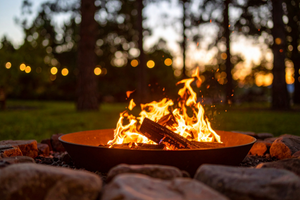
"The campfire sets the agenda."
We do not over-program every interaction. We do not force structure into every moment. The campfire handles that naturally. Somebody starts telling a story. Somebody else opens up. Business conversations turn into life conversations. People laugh longer. They stay outside later, Eventually everybody relaxes.
There is something deeply human about that experience.
In fact, I have a personal belief that it is the province of man to sit around a campfire.
The blank expression people now carry while staring into their phones or televisions is remarkably similar to the expression people have while staring into a fire. The difference is what is feeding them. One is an endless stream of outrage, comparison, advertising, noise, and other people's opinions. The other is one of the four natural elements human beings literally require to survive.
Fire.
There is something ancient about that experience.
Something grounding.
Something restorative.
Research around nature immersion, environmental psychology, and wellness travel increasingly supports this idea as well. Organizations like The Global Wellness Institute and Terrapin Bright Green have published extensive findings around the emotional and physiological benefits of restorative hospitality, biophilic environments, and nature immersion.
That should not surprise anybody.
Human beings evolved outdoors, yet modern hospitality often moves people farther away from the environments that naturally restore them while simultaneously trying to artificially recreate calm indoors.
I think the future belongs to hospitality operators who understand how to reconnect people to those experiences authentically.
That is one of the reasons we are so passionate about Victory Springs.
We are not trying to create generic lodging. We are trying to scale experiential hospitality in a way that remains emotionally restorative, nature-forward, and deeply human.
Not because it sounds trendy.
Because we have already watched it work in the real world.
Lake Longbow became a successful case study for us because guests repeatedly showed us the same thing:
People are desperate for places that help them feel like themselves again.
Victory Springs is simply the next evolution of that philosophy.
Curious where hospitality, experiential travel, and STR investing are heading next?
I spend time studying emerging trends, investor behavior, hospitality systems, and experiential real estate development.
If you would like to continue the conversation, you can schedule time with me directly.