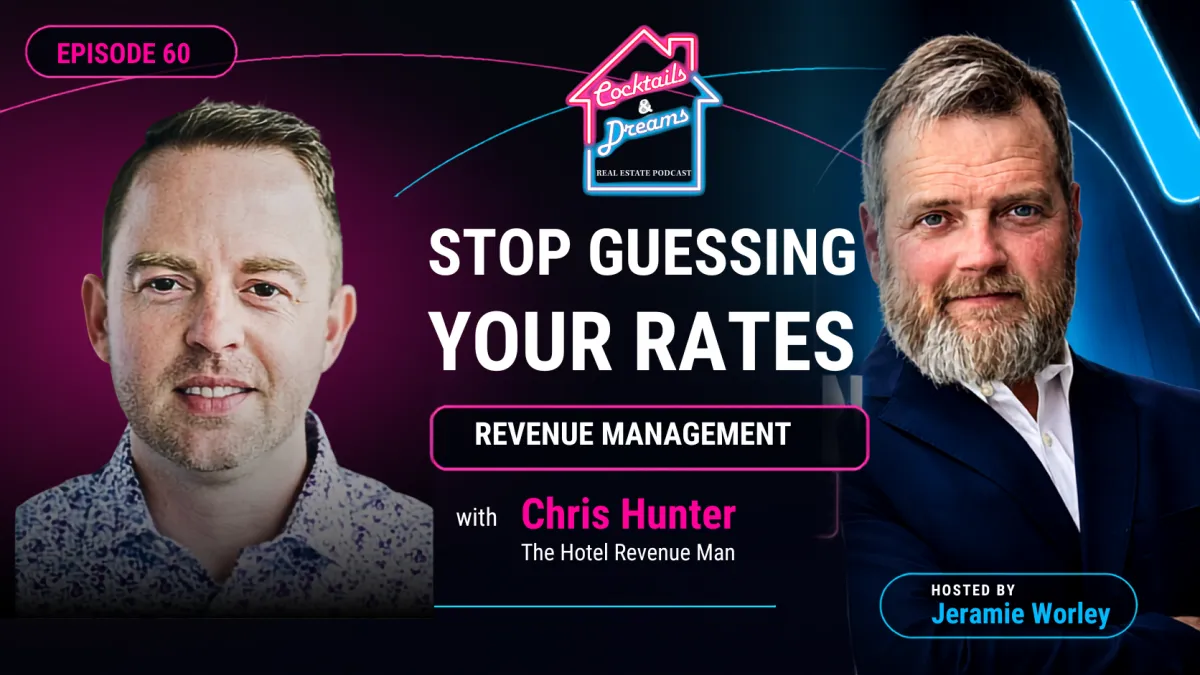
Stop Guessing the Rate: What Revenue Management Reveals About Short-Term Rentals
Cocktails & Dreams Real Estate Podcast with Jeramie Worley
Chris Hunter | The Hotel Revenue Man
Pricing a vacation rental is easy if all you do is follow the calendar. Pricing it well requires something harder: curiosity, discipline, context, and a willingness to keep checking what the market is actually telling you. In Episode 60 of Cocktails & Dreams Real Estate Podcast with Jeramie Worley, Jeramie sits down with longtime collaborator Chris Hunter, The Hotel Revenue Man, to unpack how professional revenue management works across hotels and short-term rentals.
Chris traces his path from Branson.com to hotel revenue management, explains the price-per-room framework he developed for vacation rentals, and shares why he believes software and AI can help—but still need a human operator who understands local demand. The conversation also moves into booking windows, amenities, pricing power, Branson and Table Rock Lake demand, and the modeling work Chris has done with Jeramie for Victory Springs.
https://hotelrevenueman.com/
https://www.linkedin.com/in/chris-hunter-1a806963/
https://www.victorysprings.com/
https://www.facebook.com/VictorySpringsTRL
WATCH THE FULL EPISODE
https://open.spotify.com/show/2oWeHLsHQVSJJjU9GtRBBK?si=2786c2632b8a407f
https://podcasts.apple.com/us/podcast/cocktails-dreams-real-estate-podcast/id1632712936
Editor's note: This transcript has been lightly edited for readability, punctuation, obvious speech-to-text errors, and proper names. The substance and conversational tone of the interview have been preserved.
From Branson.com to Revenue Management
Jeramie Worley:
I'll scoot in here a little bit. Okay. Well, hey, everybody. We're here with Chris Hunter today. The reason I'm here with Chris Hunter is because Chris and I have worked together for a long time across a variety of disciplines. I originally got to meet Chris because when we were doing the real estate brokerage and building it fast, I realized one of the things that we needed for real estate agents was to have data. Chris is one of the best assemblers and normalizers of data that I've ever seen. I really feel like you helped us and all of our real estate agents have the data they needed for their business. You produced it in a way that was easy to understand and they could consume it quickly and then communicate it with their clients. And it seems like revenue management is the same thing. I know you've been at revenue management for a lot longer than, you know, what I was, you know, partnering with you to do for our agents. I know that you were helping me out because I knew that you were a data guy. So introduce yourself. This is an opportunity for you to kind of brag on yourself a little bit. So talk about a little bit about why you got into revenue management, Chris, and maybe who you serve in that world. And we'll get into some cool questions about, you know, what the current landscape looks like in the Branson market and maybe what's coming around the corner.
Chris Hunter:
I'll ramp up to that. I'll give the overall umbrella of my involvement in tourism.
Jeramie Worley:
I'll ramp up to that. I'll give the overall umbrella of my involvement in tourism.
Chris Hunter:
So I got a job at Branson.com during their heyday. They were king of the pack. They had figured out how to get customers online. I started by working the phones, so I got to put together packages and vacations for people and learn all the properties, restaurants, and attractions. It was really grassroots. We would go visit each of these properties, so I became very familiar with them. Then I got promoted to the counter. People would come to pick up their stuff, and we would try to add shows and other things to help give them the best experience. Then I got promoted to business development manager, which made me the go-between for Branson.com and everything that we sold. That really helped me expand my network.
That business was purchased and my position was eliminated, and I was looking for a job, so I ended up at a hotel. They made me front desk manager, even though I had never worked at a hotel. This was during the busy summer, and after three months, there was an opening for revenue manager. So the lady who had been front desk manager had taken the revenue manager role and she hated it. So she wanted her old job back, which was front desk manager. So the owner comes to me, he goes, I think the way your brain works and all these ideas you pass along to me, I think it might be a good fit. Would you like to do that? I said, yes. I had no idea what a revenue manager was. I just wanted out from the front desk.
So I said, 'Yeah, I'll do that.' I'll skip some details, but it was very manual—filling numbers into boxes on all the websites. I said, 'This is not going to work.' So I developed systems where I would go into our hotel, change the rate and availability, and it would upload everywhere on the internet. It saved us hours and hours of time and kept all the information straight. That's how I started getting into it. I started looking at all these different patterns. That's what fascinates me about data, because that's where you can see opportunities or dangers. I developed different systems that would give the properties I worked with a competitive advantage.
I know that because there are companies like Expedia and others in the industry that told me that the things we were doing at our hotel were different from and better than what others were doing.
Jeramie Worley:
So let's talk about that a little bit. So what were you doing that was different than and better than others?
Chris Hunter:
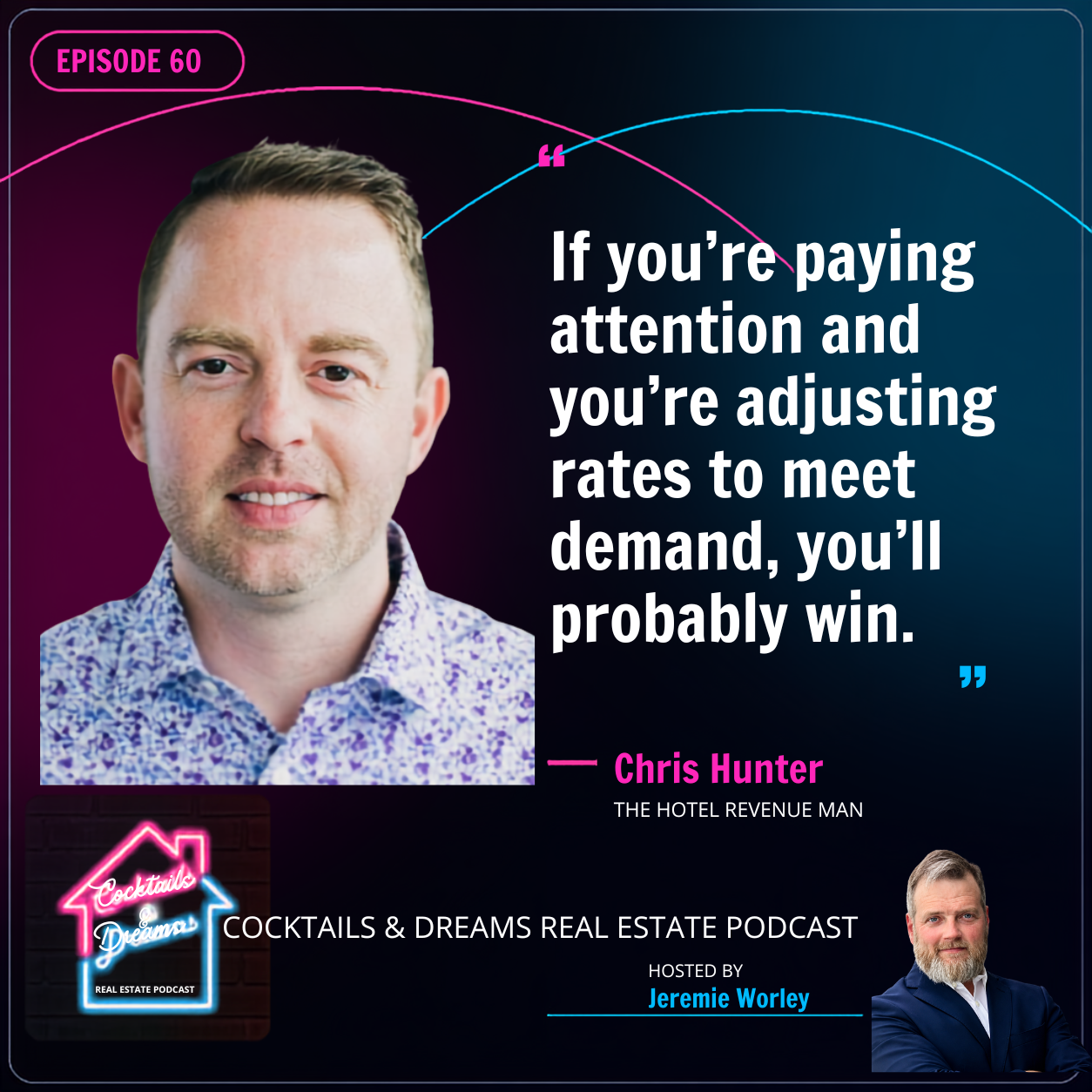
Expedia came to me and said, you are one of two people that figured out how to steal market share. I said, 'Who's the other one?' They said, 'We can't tell you.' Oh, boy. So I'll be a little coy and speak a little vaguely here, but it was in yielding rates, which is just a fancy way of saying changing rates. You'll hear me say this a lot, I expect, throughout this: if you're paying attention and you're adjusting rates to meet demand, you'll probably win. So that's what I was doing. I had figured out one specific strategy and it was picking up occupancy during times of low demand. So because our properties were paying attention, I was turning all the right dials and it worked out.
Chris Hunter:
And someone else had figured out the same thing too.
Curiosity, Data, and the Price-per-Room Lens
Jeramie Worley:
Well, that's fascinating. So what, without giving away any trade secrets, what was it that made you go down that road? I know you said you love to recognize patterns, but go a little bit deeper there. Tell us what was it about that inspired that?
Chris Hunter:
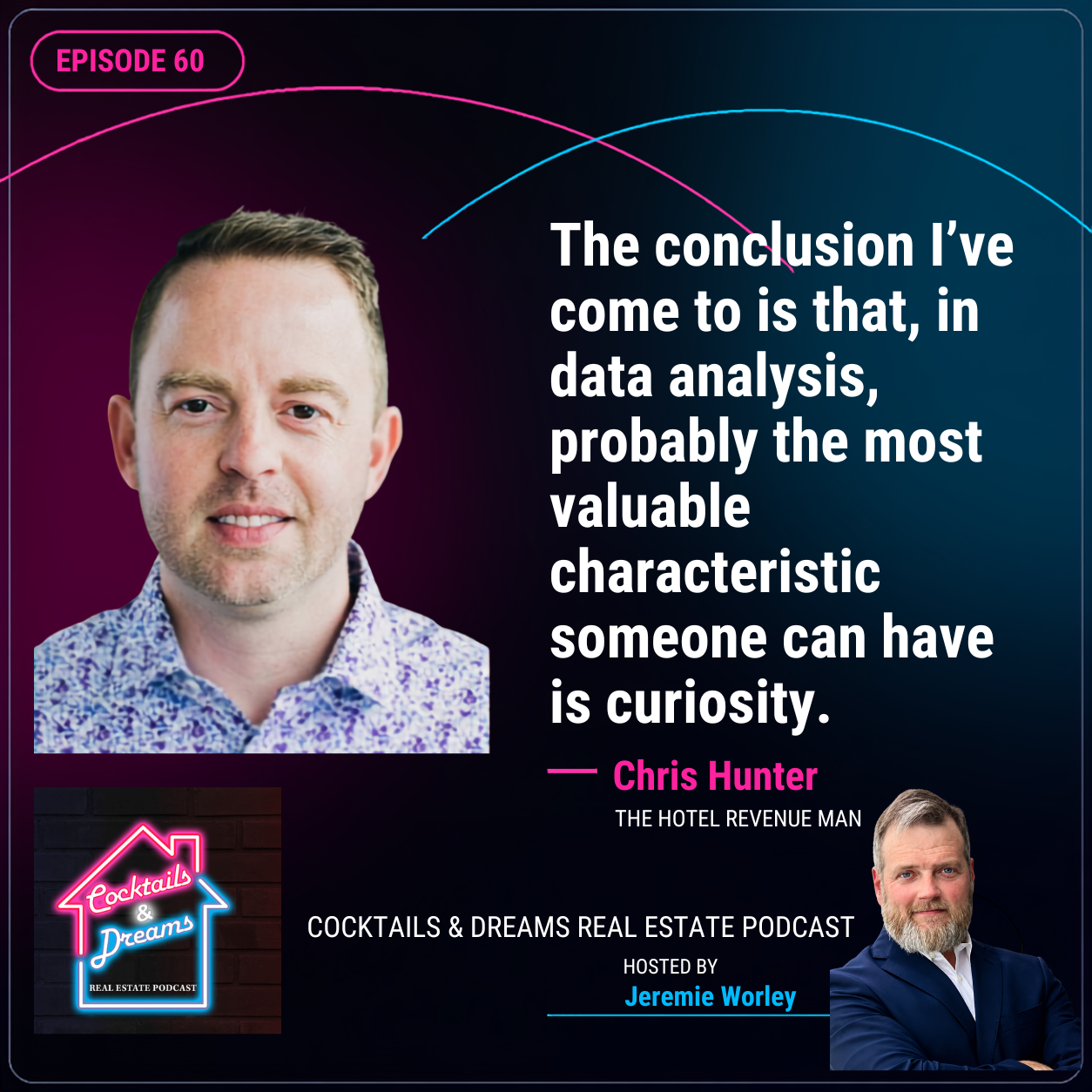
The conclusion I've come to is that, in data analysis, probably the most valuable characteristic someone can have is curiosity. So I wonder if a Wednesday in June is busier than a Tuesday in July, what's the busiest day of the week? What day do most people check out? And I'll tell you, it's Sunday. And I'm sure that you're aware of this and this is, I'm going to speak tourism in general. So this is going to be lodging, this is going to be a hotel, short-term rental, vacation rental. It's, it's all very similar in this area. And with that curiosity, I can see how much demand a weekend day has versus a weekday. So that story should affect the rate. Well, by how much? It's just continuing to ask questions.
Chris Hunter:
I teach my clients: if you're willing to dig deeper, you'll find more valuable information. A lot of people either don't know to do that, don't know how to do it, or aren't disciplined enough to do it. I had time to delve into it, so I did.
Jeramie Worley:
So because you originally got your start at a hotel and then, you know, over the past 15 years or so we've had this massive surge and introduction of short-term rentals. How has that affected the way you either analyze data or the way you integrate or, you know, how do you really look at the two types of asset classes differently, a hotel or a short-term rental?
Chris Hunter:
Let me tell you my introduction, my baptism into vacation rentals. Four years ago I was working for a company in town. They managed 500 vacation rentals. So they gave me an office, a standing desk and a computer and access to all the things and they said, 'Here you go.'. And it was amazing. They were very cutting edge. If there were a tool or a program that someone needed, they paid for it. So they're really aggressive and successful. So I instantly had access to all this data and I was just, my mind was blown. It was all vacation rentals—everything It was everything from a studio condo, one-bedroom cabin all in town, all the way to a 10-bedroom mansion. So curiosity again, I go, huh?
If I had the money, I wondered whether it would be better to buy ten one-bedrooms or one 10-bedroom. So I started calculating, I wondered whether it would be better to buy five two-bedrooms or two five-bedrooms. So when I'm fiddling around with this, I actually made a video about this on my YouTube channel, Hotel Revenue Man. I started to develop this metric and I call it PPR, which is price per room. So it evaluates a property based on the number of rooms, with a 'room' being a bedroom, of course. So I could see my different properties and at different times of the year which was performing strongest. I would start my days for a specific upcoming week or weekend. I would do this over and over all day long.
And I'd say, okay, let's start obviously with my one-bedroom. So you've got your one-bedroom and it's going to have a bathroom, it's going to have a kitchenette, and it's going to have a living room. So that's going to be a base. Then if you have a two-bedroom, you might just add on a bedroom, probably another bathroom, and you just add on from there. So I was looking at price per room and I was looking at the size of the unit. So I'll make up some numbers. Let's say I've got a studio or a one-bedroom condo and it's going to be a hundred dollars. Okay. Then I would look at two-bedrooms and I have this way of shopping the market to see what the market price is bearing. So then I price a two-bedroom and it's $75.
I'm like, 'That doesn't make any sense.' Then I'd price a three-bedroom and it'd be $200. Well, if a one-bedroom is $100 and a three-bedroom is $200, a two-bedroom should be about $150. So I'd go look again, calculate the numbers, crunch, and shop. I'm like, it's saying if I want this to sell, it has to be $75. Then I got access to data that said—this was years ago—at that time there were more two-bedrooms than one-bedrooms and three-bedrooms combined. I go, 'Oh, that's the story the data is telling me.' So when you're talking about growth, are there certain unit sizes that have been overbuilt, or was that for a certain time and things have been corrected?
I do know in the last year, even with the growth of units coming online for vacation rentals, the ADR, or average daily rate, has not only held but increased, I think about 4%—somewhere in the 3% to 5% range. So that's a really good sign that all of this is coming online. People think this market is strong and it was able to absorb that.
Jeramie Worley:
Well, the interesting thing about Branson is that it tends to be, it seems, a recession-resistant market just because of the driving destination from half the United States. So when the market performs really well, when people have disposable income, they may take a trip to Florida, they may take a trip abroad, and they may take a bonus trip to Branson before the summer is over. Then when the disposable income is low, people will oftentimes just take a driving trip to Branson, you know, so Branson seems to suffer recession time frames fairly well. Plus it is a low-cost family destination as opposed to like a Las Vegas where your shows are just going to cost three times what they cost here in Branson.
So what I really love what you're talking about is not just data, but also the marriage of data and context, which data without context can oftentimes kind of feel out there and like disconnected. So what are your opinions on context and data?
Chris Hunter:
I think context is key. The hotelier I worked for—the one I was telling the story about—owned four properties, and I got to work for all of them. He told me the same story. He said, 'Okay, it's time for a recession. Instead of flying to Florida and going to Disney World, they're going to throw everything in a car and drive.' As a revenue manager, Branson will consistently be recognized as an affordable vacation destination. Everyone stands up and cheers and wants to have a parade, and I want to go, 'No, this is terrible news.' As a revenue manager, it tells me you're not appropriately pricing your units. I tell all my clients: we want to give our guests a great experience. We want it to be a good value.
We don't want to be cheap. We don't want to just give everything away. And everything is so inexpensive. You know, make it be a great experience. And also that has a cost to it. And we'll just match that up so that we can find the right customer for sure.
Hotels vs. Short-Term Rentals: Cost, Value, and Pricing
Jeramie Worley:
Well, that's fascinating. So any other real differences in short-term rentals and hotels? Because as I'm out there raising capital for, you know, the Victory Springs development, which is a, it's a bit of a hybrid, it's a short-term rental development, but we have some studio type units and we'll have larger, you know, three bedroom units and bigger. What I'm finding when I'm talking about creating financial models for people who are already in the hospitality world, there's two things that don't really match up when you're talking about hotels and short-term rentals. And one of them is the, I guess the expense ratio.
Because the expense ratio for short-term rentals, which is more of a guest-driven business model than a front-desk-driven, there's a service person available for you daily cleaning, on-site laundry, all of those things with short-term rentals, people are checking in, they're checking out, they're starting a load of laundry on their own. Then a cleaner comes in as a third-party contractor. The guests usually pay that cleaning fee. There is no on-site restaurant. There is, there's not this like commercial-heavy presence. It's really just a residential home that you go in. What, in your opinion? Oh, and then the other part of that is the overall like build cost because most hospitality companies are talking about well, what's the RevPAR—revenue per available room?
Well, you alluded to this earlier when you said hey, you might have one house but you really have to adjust those metrics down to the bedrooms. So you know, we kind of affectionately call it RevPAB, you know, which is revenue per available bedroom, you know, rather than per available room. But because in short-term rentals you have to calculate it that way because it's, you're really increasing your price metrics. It seems to me like the largest price driver is how many does it sleep. Then after that you get minor changes or you know, changes based on the amenities available location, proximity to pool or clubhouse, walking distance to this or that location, to amenities, groceries, privacy, the lake, things like that.
So in your experience when you're working with hoteliers and also short-term, you know, rentiers, how do you advise the two with those kinds of things in mind?
Chris Hunter:
One of my two most popular videos is 'How much does it cost to put someone in a room?' Now, this is in the context of a hotel, but the same very basic principle can hold true. It has to be adjusted based on certain things. Hotels talk about room nights because they have multiple units, but you can do it based on whatever your units are. If you take all of your expenses for, let's say, a given year—2025—and divide them by the number of nights booked, that will give you the cost to rent it out. The reason I guide people with this is that, if you go shopping on Expedia for hotels as an experiment, there are some really solid properties priced surprisingly low.
Well, I'm going to use motels as an example. Motels most people understand as a motor hotel or one where you can pull your car up to a 1950s-era building by the side of the highway. You know, very basic, very budget. There are some that have good review scores and their prices are so low. I know how much it costs to put someone in a room and they're right there. And sometimes below looking at a PPR, price-per-room metric, I see short-term rentals doing this and when I saw this, I was working for that company, had access to 500 units, I was shocked. It's especially the large units, really large units during times of low demand, a PPR I'll make up numbers again, might be $30. I tell people would you go stay in a $30 hotel room?
I say, 'No,' because that sounds scary and you can think of the context we're talking about context. I go well this 10-bedroom is running for $300 which there are a number of them and there's little to no demand at that time of year. So I get it. But the problem is sometimes you get people who pay $30 for a room and that can invite other issues.
Jeramie Worley:
Right? For sure. So let me ask you this. Most people think that revenue management means raise the price when demand is high, lower it when demand is low. What are they missing? Or what's some of the, you know, the secret sauce that kind of goes into revenue management.
Chris Hunter:
I'll reframe it. And I'd probably say it's finding value. When we're looking to go on vacation. My wife's looking for a hotel room vacation, usually vacation rental. And we're sort, I teach her how to sort data, see if we can get one to pop out. That's, that's great value. And sometimes everything is just expensive. And she goes, you revenue managers, you did this. Well, people have found out at that time for that area, that's what this thing is worth. So you're just gonna have to pony up the door, you're gonna have to find someplace else. I also tell my clients it's not just, it's not let's take advantage of people during times of high demand and take that and just crank the number up and hahaha, we're going to separate them from their money.
The flip side of this is there are times there are opportunities for us to discount this same amazing, beautiful, wonderful property and this great experience we're going to give our guests. You want to come Independence Day weekend, July 4th weekend, Friday and Saturday. I mean, you can. You might pay the most you will the entire year, but guess what? I can get you a discount. Can you come in the Monday after. Can you stay Monday through Thursday on weekdays? You can save a significant amount if you're willing to do that. So it also affords you the opportunity to. To give a discount to those who might want to enjoy your property. Also, in regards to the context of finding value, there was a motel from Florida that found me online, and so they hired me to help them with their rates.
They had a horrible customer review score. I'm going to say 2.3 out of 5. You've got to have at least a 4. That's just the basic experience.
Jeramie Worley:
Like stars? Like five stars?
Chris Hunter:
Yeah, like a customer review.
Jeramie Worley:
Customer reviews. Got it.
Chris Hunter:
As opposed to the level or class of the property—thank you for that. So, yeah, like a customer review score. I was like, 'Okay, do you have some money we can work with? Can we remodel some rooms?' He said, 'I don't have any money.' This was like a last-ditch effort. He had just been on the show Hotel Impossible—like Bar Rescue. They come in and say, 'This is a disaster. Let's get it in shape.' That was a year before, and it still was not good. The property was a U-shape around a pool, and it was two levels. I said, 'We'll make up numbers. How much does the room cost?' '$50.' 'Okay. They're all the same?' 'Yeah.' 'Let me guess. You don't have an elevator.' 'That's correct.' So everyone wants ground floor. 'How much is ground floor versus upstairs?'
It's all the same. No, it's not. Not anymore. Ground floor is plus $5. That's plus 10%. Okay, we got poolside. What's on the other side? Parking lot. So let me guess. Everyone wants to stay poolside. That's correct. How much more is that? No, it's all the same. No, it's not. It's plus $5. So if you want to say ground floor poolside, that's plus $10. That's 20% higher than the 50 rate. Now, if you want that experience best experience everyone wants, there's that. If you need a discount, if you're willing to climb the stairs and you're okay with the parking lot view, I can get you a $10 discount. So there are opportunities for discount, but there's also opportunity to find value that was just overlooked.
Jeramie Worley:
I love that because essentially you're creating value out of thin air. Even though it does have demand. You, you are just recognizing the demand there. Like, for example, I did a small version of this with my kid. My kid was like, dad, when can I start cussing? And I'm like, you can't start cussing. And he's like, dad, I just want to say some cuss words. And I'm like, well, start paying taxes. Then you can cuss. You know, that's what my dad told me when I asked him the same question. Then I thought, okay, I can create some value here. I mean, like, okay, if you want to say one cuss word, I'm going to charge you 50 bucks. You can say one cuss word for 50 bucks.
And he thought about it, you know, so it's like I created value out of thin air. I know I could have gotten at least 15 bucks out of my kid if he wanted to cuss on that drive. Just because, you know, I was in the authority position, I had the ability to make those rates. And you know, when I think about revenue management, I think about that in a very similar way because the value isn't out of thin air. You're really just identifying those demand drivers that people are willing to pay more for.
Chris Hunter:
Yeah, yeah.
Dynamic Pricing, AI, and the Discipline of Reviewing Rates
Jeramie Worley:
So I know in the short-term rental world over the past couple of years, we've seen a lot of dynamic pricing engines come out. You know, are those valuable? Do you find and. Or what is like one pricing mistake that you see short-term rental owners make that kind of quietly cost them thousands of dollars a year.
Chris Hunter:
Okay, so I had a client who said, we found the software. This was recently, within the last six months, we found this software. It's AI, it's revenue management software. They said, don't worry, we need you. You're valuable. You know, Branson, you're not going anywhere. This is another tool we're adding to our toolbox and we're going to use it. I said, great, let's do it. I said, now in my position, what I'm supposed to say is, this is all terrible. This is all stupid and it'll never work. And. But I'm gonna tell you, I'm not going to sabotage this experiment. I trust you. Let's use this to help us. When people use software, there's a big assumption. This is what I Teach my clients. There's a big assumption that you're making that it knows what it's doing.
My job was actually secure when they started using this because I meet with my clients once a week, typically for an hour. We look at upcoming rates, choices we made in the past week, and how everything worked out. We spent the entire time correcting mistakes from this software. It's not just me saying that, because there's a small team of people—anywhere from two to five, depending on who's there that day—and we're all making decisions together. I'm coaching them and telling them what I see. That software company has since gone out of business. The property I was working with was getting ready to break up with them anyway and say, 'Hey, we want out of our contract because this isn't working.'
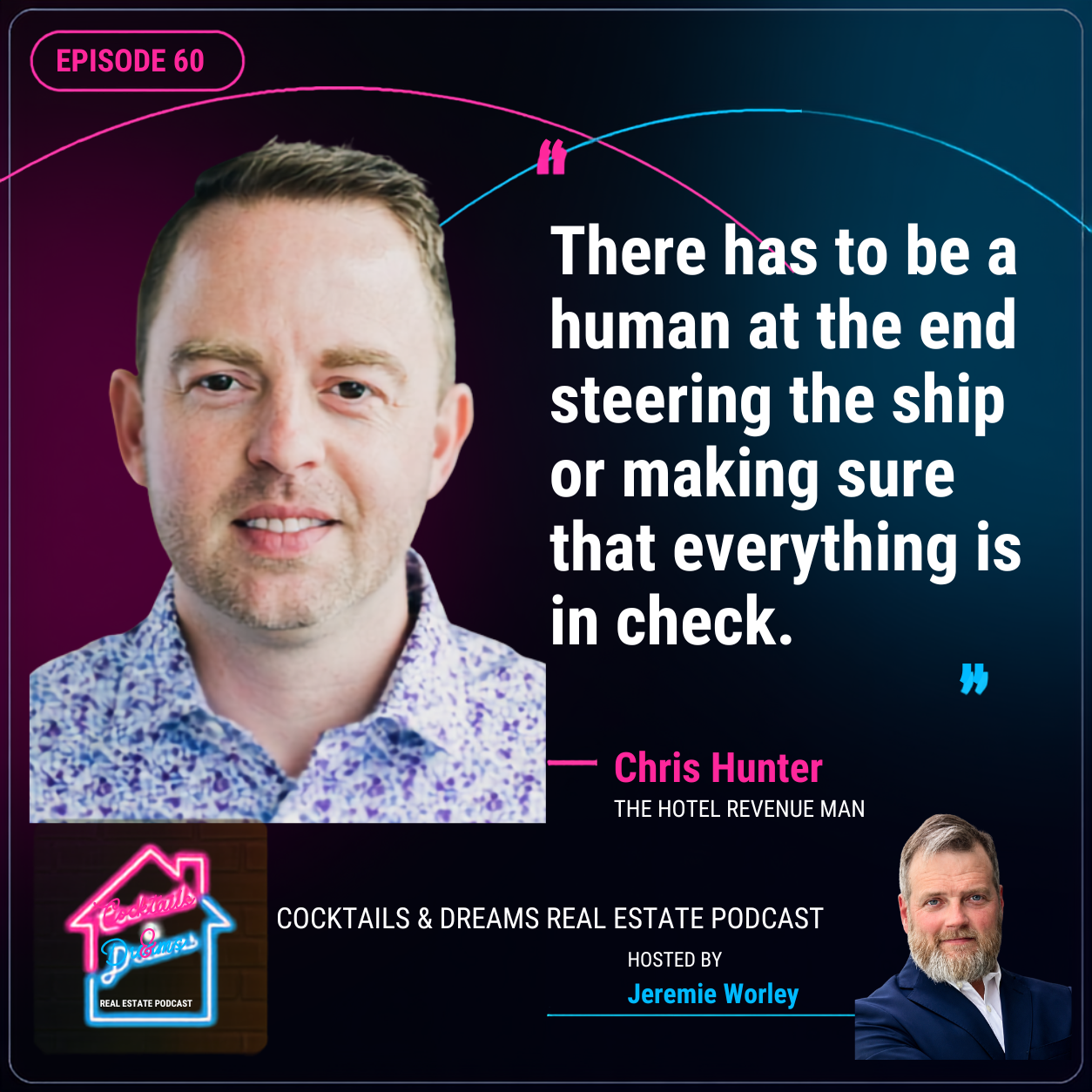
If someone uses technology to help them, I am all about that. But as of right now—and this is probably not objective—there has to be a human at the end steering the ship or making sure that everything is in check. This software was supposed to be cutting edge and using AI, and it was taking Tuesdays in July and doubling the rate. We're going, 'It's July, but it's Tuesday.' The story it was telling didn't make sense. I have another system I developed, and this is what guides our conversations. When I meet with clients, it records every future day's occupancy and rate. I come back the next week and we have the same information. I'm like, 'Why has that Tuesday in July not moved for three weeks?'
Chris Hunter:
Like, it shows these patterns, right? And we looked and we're like, oh, it's double Monday's and Wednesday's rate. And we're going, oh, man, we got to go back in and we got to correct it. So that's what we were spending our time doing. But that's in regards to technology. And what was the other question you asked there at the end?
Jeramie Worley:
It was, what quietly costs short-term rental owners thousands of dollars per year?
Chris Hunter:
Okay. I answer nearly all the questions with the story, but that's just kind of how my brain works.
Jeramie Worley:
Yeah, I love it.
Chris Hunter:
I had a client—the general manager and the owner. The three of us would meet every week. The owner said in front of the general manager, 'Chris, we don't need you. We could do this without you.' I agreed with him. They're smart guys. They could have gotten about 90% of the way there. They really did know what they were doing. He said, 'But your main value is that, because we pay you what we pay you, every Tuesday at 10 a.m. we have to stop everything we're doing. We're short-staffed, everything's on fire, the bus is coming, we've got to get all the rooms clean—but it forces us to stop and look at our rates.' That is the number one thing you need to do.
You have to stop and you have to take the time and the discipline to look at each future date and to see what the competition's doing and to see where it was last week and dig a little bit deeper. So that's the thing that cost the most money. My clients will get nervous because how much should a unit cost on Black Friday? They're like, I don't know. And I'm like, nobody knows it's the future. But the most valuable information is past information. Did you have this last year? How much did it sell for? That's really good information, right? And you look at the market, does the market sell out? Maybe, maybe. Okay, well, that's good information. Tell people, as a revenue manager, I'm a professional guesser. And the nobody knows the future.
But the more pieces of information and data that we can gather, the chances that we make a good decision really increase. And you don't have to make a perfect decision. You have to make a good decision. Then you check back in a week, and then you adjust and you check back in a week and then you'll dial in an even better decision.

Jeramie Worley:
So it is a dynamic process. It is a fluid process of constantly looking and checking. So let's say there's a short-term rental owner out there. Let's say that they're maybe even evaluating a new property. And when. So when you are looking at a property through the eyes of an owner, from the eyes of somebody who's paying the bills, what are you looking for? When you're thinking, okay, this property can outperform the market,.
Chris Hunter:
Probably unrealized potential. You're like, 'Okay, what does that mean?' I had a client who bought a property next door. It was owned by Grandma and Grandpa, who had owned it for 25 years. Rates were printed on a piece of paper and handed to the local resellers. I said, 'You bought this property?' 'Yeah.' Rates changed almost nothing from year to year. I said, 'You just stumbled into a gold mine.' Why? We were talking about the importance of checking in regularly. You don't have to make a perfect decision, just a good one.
Jeramie Worley:
Right.
Chris Hunter:
They weren't making any pricing decisions. Their rates were frozen from almost 25 years ago. I said, you just, I don't know if you know what you did, but you just found a gold mine. Because you see this date, I'm going to turn this one up, is this, I'm going to turn this one down. You're going to have all this new opportunity. So if there is a property that hasn't been regularly, consistently evaluated, there's a possibility that there's unrealized potential there.
Jeramie Worley:
Well, I would say that now when people are purchasing individual short-term rentals, it doesn't really matter what the aPPRaisal says anymore. I mean, the market has changed so much that now you know, it's largely based on cap rates. So people, when they're buying properties, they're backing into the purchase price based on what the property has done performance wise. So that could be a cool nugget for people, you know, as they're going out and looking for properties, because you have to use both the historical and data to know. Because when I first got into the business, this was back before Airbnb was invented. I had to ask my clients if they would let me borrow their tax returns so I could.
I would get permission and I would black out their Social Security numbers, black out their names, or just get the Schedule E or Schedule C sometimes, as the case may be, so I could show them, hey, this is a document that my client sent to the IRS that said how much this property could make. Because I always joke and said I had to lie to people in the beginning because a five-bedroom, when I told them that it would do 50,000 a year, people would hang up the phone on me and they'd be like, this guy's a shyster. He's trying to sell me on something. So I was like, these properties would do 25,000 a year. Then when I would check on them, they'd be like, why didn't you tell me they do 50? I would have bought two of them.
Human Behavior, Branson Demand, and Market Timing
Jeramie Worley:
And I'm like, well, you wouldn't have believed me if I told you know, so those things were real. And, you know, it really matters based on all of that. So here's a question then, kind of along those lines. How much of revenue management is math and how much of it is Understanding human behavior.
Chris Hunter:
Math versus behavior. So the hotelier I worked for, he owned four properties, 800 rooms total. He said revenue management is part math, part art, and part pure guts. Because you can do the math and you can set up a fancy strategy. Then you got to capitalize because you know Independence Day weekend's gonna sell out and everyone else's rates are lower, but you don't care because you know the whole town's going to sell out. Everyone's gonna need your rooms. So now you gotta hold if that's your strategy. So that's the math part, then there's the human element. So I predicted at the beginning of this year for my clients, I said, last year was heavy late demand—heavy late pickup. Money's a little tight. People weren't real sure if they're going to travel.
I said, 'I think this year, from what I'm seeing'—and my system collects the data to see what's growing and what's not—'I think it's going to be even later and still heavy.' That makes it really hard for revenue management because, like you're saying, you do the math and put together a strategy, and then: do you hold, or do you drop and try to pick something up? You have to be watching human behavior. That probably includes seeing what's going on in the news, trends, or AAA reports. They said Independence Day weekend was going to break a record. They said that for Memorial Day weekend as well, and for Branson, it was soft. So I don't know that national forecasts always translate locally. The math is good.
That will help you figure out trends and then behavior, I guess it's always changing. So you just got to watch and see when people are ready to change,.
Jeramie Worley:
You know, when it comes to data and things like that one. Actually, I've been hearing the same thing from banks for the past few years. And banks would say, well, we're saturated, we're saturated. I would say, well, what metrics are you using to track saturation? And the banks could never answer the question because what they meant when they said saturated was that their portfolio was saturated, not the market is saturated. Because I'm thinking, well, gosh, I mean, the. The average daily rates are still continuing to go up. This has to go. This goes back to human behavior. The booking windows, you know, we were still having incredibly long booking windows, we would. We would, you know, welcome. We would say goodbye to some guests when they would leave and we would clean the property and welcome them back.
They would book the next year. Already, you know, you see long booking windows because back then we didn't have a lot of, you know, 10-bedroom, larger properties. We kind of pioneered that. So were always, you know, always full on our properties. And of course, you know, we sold out before the market became, you know, a little bit condensed with some of those just because, you know, we've got our thumb on the, you know, the jugular of the market all the time. So we noticed that and we know, here's the human behavior thing that I noticed in the beginning and still this still holds true. But more so in the beginning than now, what I noticed is that it was typically the matriarch of the family who was booking the short-term rental for the whole family.
Chris Hunter:
Absolutely.
Jeramie Worley:
Properties with pool tables would book like crazy. Not because mama liked to smoke cigarettes and, you know, shoot some nine ball. It's because she wanted to be able to go to the husband or her kids, her boys and say, hey, I got you a pool table. That's going to be great. And they're like, that's all I care about, you know?
Chris Hunter:
Yes.
Jeramie Worley:
We also have, you know, 3 million people turning 30 every year for the next 24 years. Millennials love short-term rentals. That's how they like to travel. On the last data that I checked, 14% of millennials are buying short-term rentals before they even buy their own primary home because they like to rent.
They don't want the maintenance issues, but yet they like to own something and they want to develop some equity in a piece of real estate and have that place they like to get away. So all of that to kind of agree with you when it comes to human behavior, because I think that can't really be dismissed. It's not just a data business, although it might be a data heavy business. So let me ask this question now. In a market like Branson and Table Rock Lake, what demand patterns are you seeing most? Is it holidays, school calendars, concerts, lake seasons, Silver Dollar City events, anything else or anything that you're seeing that worth talking about.
Chris Hunter:
When I had access to hotel data, curiosity kicked in. I wonder what the busiest day of the week is. I wonder how weekends perform versus weekdays. Now, this is from years ago, but I'm going to say it's. It holds probably exactly true if I got my hands on the same data. So I grouped. Now this is Branson. It probably holds true a lot of places. Sunday night through Thursday night we call weekdays, Friday night and Saturday night we call weekends. So I saw that any weekend day had twice the demand of any weekday. So grouping them all together, any given weekday was 11% of total bookings for the entire year and any weekend was 22%. So it just worked out perfectly like that. So that's good to know. And that is something that is going to hold consistent with vacation rentals or just lodging in general.
Holidays, of course, are big. We're seeing late and heavy booking patterns. I recently heard a member of the lodging association discussing Chamber/CVB data—the Convention and Visitors Bureau. I tell people the CVB gets people to Branson, and the Chamber promotes businesses while they're here, so there's a handoff there. The CVB has access to this data. She was talking primarily to hoteliers. She says, 'Who's up?' A couple hands went up. 'Who's even?' No hands. She's like, 'Oh, y'all nervous?' Nobody wanted to share. 'Who's down?' Nobody wanted to share. She said, 'I'll tell you,' clicked to a presentation, and showed the data month by month. The first quarter had actually done fairly well.
But as you know, it's slow season, so there's not a lot there. Then the data showed the market a little behind. I did some further digging in preparation for our talk because I figured we'd discuss trends in the area. The post-pandemic years had a lot of pent-up demand. Oh my gosh, it was a good time to be a revenue manager because it almost looked like a cheat code—you couldn't make a wrong decision. Maybe you could have made another dollar, but it was great. Now things are slowing down a little bit. The research I saw described 2025 as a correction year and 2027 and 2028 as strong, even specifically in our area.
So they say if you're a genius you're building now and maybe think of like Warren Buffett, when everyone else is scared, you're going for it. So they say if someone's working on something now to capitalize on 2027 and 2028, then that's probably a good move.
Jeramie Worley:
You know, COVID proved my thesis, which is people don't stop vacationing, they just vacation smarter. And tourist season and travel is a lot like home buyers because home buyers are the same way when interest rates get really high, or home affordability gets low, or things happen in the global marketplace that freak people out and people are like, well, I'll just stay here for another year. Well, in that year, your home wears out a little bit. You get a little bit more tired of it because you got another dog. And now your kitchen is a whole lot smaller because you're having to walk around this German shepherd that you got. The kids' toys keep taking over the house, you keep having more kids, the house keeps getting smaller and smaller. And it really does create a pent up demand.
Now I've always told people in real estate that this is the kind of thing that people are always going to need help from an expert on because people are born, people pass away. You know, there's the life cycle of humans, you know, who need a place to live that's always going to be there. But I've seen huge pent up demands where there's these years where nothing happens and a lot of real estate agents leave the business and then all of a sudden, boom, you have an explosion year and you and everybody has a banner year because there's a third of the agents that actually stuck it out who are actually full time agents. All the plumbers that were doing real estate deals on the side, they go back to being plumbers or somebody gets other jobs.
Amenities, Pricing Power, and Booking Windows
Jeramie Worley:
So pent up demand is a real thing for sure, I would say. So let me ask you this. What is the difference between a property that gets booked and a property that has real pricing power? Because sometimes I have found that your basic studio properties with not a whole lot of amenities, they just book, book, book. Because people are just looking for a place to stay. But then you have these other people that are like, no, I really want these individual amenities or I want a place that I can go for a walk in the woods, or I want at least a view of the water. So I'll kind of combine this with another question which would be like, how do people think about amenities? How should they think about amenities? Hot tubs, pools, fire Pits views.
What's your, what are your thoughts on those Chris?
Chris Hunter:
There are some amenities that really matter. I have a friend named Brad who has a lot of vacation rentals in town, and he showed me the data once—this was years ago. He had picked up some properties; I'll make this up and say they were three-bedroom homes. He had a few around town, some with hot tubs and some without. He showed me the metrics on the ones that had a hot tub and the ones that didn't. That was the only difference, even in similar parts of town, and it was huge. He would spend his time looking for used hot tubs on Craigslist or Facebook Marketplace. I've seen the data on one specific amenity—a hot tub—and yes, it was significant.
So I would suspect like you're saying about the pool table, billiards table, that's a thing, you know, a deck, people want to go out on the deck. A grill, people grill. After a long day at Silver Dollar City, what I've learned is that you have to have a story for these things and it has to be a reasonable story that makes sense. And there's some stories I even from your vacation, your early large vacation rental days of there's a softball team, we can go get nine hotel rooms at $100 a piece or we can get a nine-bedroom vacation rental unit for 900 a night plus we get a hot tub, plus we get two decks and two living rooms. And like, well, that seems like a pretty easy story.
Jeramie Worley:
So the experience is different too because ultimately they're not all hanging out in one person's room causing complaints for the hotel. You know, you can hang out in the multiple living areas. People can wake up, have a cup of coffee together. There's more opportunities to just hang out which is why people travel together anyway.
Chris Hunter:
Yes. I think there are amenities—I don't know all the amenities and which ones have value—but if someone is paying attention, they can learn. If you have social media set up for your unit with its own special name and guests can check in and tag you, you're going to see whether they're playing the video game machines, playing pool, using the pool, or grilling. You're going to see what gets used. And here's your cheat sheet: talk to whoever is cleaning your property, because they'll know if they're having to clean the grill, if things are broken, or what's getting used. They might have some insight for you.
Jeramie Worley:
Good thoughts. Here's a mistake that I made early on in my career. My first short-term rental, the first time I ever booked, I think we bought the property. Well, it was in September. I remember because it was my wife's birthday the day we closed on the property. So a crazy time to put a property on the market because you're pretty close to the off-season. But this is back when there was absolutely zero short-term rentals in Branson. There was just a few condos, there wasn't many houses.
I was really eager to get some bookings for this place because we had just, you know, written the big check to buy this property and somebody, my first inquiry and they really kind of worked me over on the rates a little bit and I was like, I don't care, I just want to get it booked so, you know, I can go tell my partners, hey, we got a nice week long thing booked. I didn't realize I was negotiating my rates for Thanksgiving week. I was like a little flabbergasted at myself because I proceeded to get about 25 different inquiries for the exact same week after I booked that week. And that was one of those lessons for me, like never negotiate Thanksgiving week. So this is my question to you.
How do you decide when to hold firm on rates and when to discount?
Chris Hunter:
Broken record: you've got to be checking regularly. The more familiarity you have with a market, the more you'll know that Thanksgiving week in a Branson vacation rental is a time to hold. Here's another metric—a pro tip for whoever's listening with a vacation rental. If I have a hotel with 100 rooms, I can say, for Thanksgiving week, I've got 90 rooms available. The next week I've got 85, and the next week 73. You get this demand curve. You can track it in an Excel spreadsheet—because I do. But if you have a short-term rental, you have one unit. So where can you find a demand curve?
I love to shop like a consumer. The easiest place to do this is probably Vrbo. Pick Thanksgiving week. If I have a six-bedroom, I'll sort for six-bedroom units. You've got your map, right? In the corner it might say 300 search results. The next week you check and it says 293, then 260. You go, 'Whoa, they're starting to disappear.' This is your booking curve—your demand curve. So you can track it that way. It's a combination of rate and booking window. We need to know: is this a studio?
One- and two-bedrooms, and often even three-bedrooms, will behave more like hotel rooms, where the demand curve continues to increase toward the day of arrival—especially in the last week. It's not crazy to say, 'I got my two-bedroom booked a week out.' You'd like more leeway, but it can happen. If you've got a 10-bedroom, when are you supposed to drop the rate? What's the danger zone? I made a video—it's probably my most recent video—called 'How to Price a Vacation Rental in Any Market of Any Size Unit.' It deals with PPR, price per room, and shows you how to figure that out. It's pretty simple. The other thing I tell you to consider is booking window.
You go, 'Well, what's my booking window?' It depends—the revenue manager's favorite answer. What size is your unit? I'm going to give you a very generic rule, and you have to adjust from here. I have found a good booking window is about one month per bedroom. So if you've got a five-bedroom, what's the booking window? Probably about five months. What's the danger zone? One week per bedroom. If you're five weeks out and you haven't booked your five-bedroom, it's likely not going to happen at the original strategy. So you know the five-week point is coming up and you know the five-month booking curve. How nervous are you that it isn't booked yet, and how important is it to you that it gets booked?
That's when you start turning the dials and see if you can play Let's Make a Deal.
Modeling Victory Springs and Building a Consistent Brand
Jeramie Worley:
I love those practical shoot-from-the-hip metrics. When I was helping people come up with purchase strategies or pro forma strategies, I would always say, and I got this from a book, it was one of the first books that was out. I think I wrote the third book on short-term rentals that was out. But the first one I read two or three times and it was a great book. And the metrics that the person that the author used in that book were very true. And it was basically. And it may not be true anymore, but back then it was. And it allowed me to provide great advice for people. And it was like the shoot-from-the-hip metric. When looking to see if a property that you want to buy is going to work. It was 100 nights.
If you can take 100 nights of peak season rates, you know, not every market has 100 nights of peak season. Branson maybe does. You know, we're kind of close to 100 nights. But I said, if you can book this thing out and rent it for just 100 nights, which is less than a third occupancy for the whole year, you should be able to make it work. Because if you can make it break even on those hundred nights, most likely you're going to be okay. Then of course, when I built my pro formas, I built them not off of an ADR, I built them off of a discounted rate like the shoulder season rate and also the peak rate and the off-season rates I always factored zero for because I didn't. I was very conservative.
So every property that we analyzed or did a financial model for, we said, you're not going to get any off-season rates, even though that may not be true. And we're going to build this pro forma off of discounted rates and peak season rates. Which is why I love what you did for us with Victory Springs, because when you shop, you actually put the percent occupancy in there. So we built our financial model off of real rates that you've shopped on similar properties. I love the way you built our model because ours is a brand new development. It doesn't exist yet. So it's like, how do we know what we're going to get, especially when we have these standards and we don't exactly know how we're going to do off of these standards. So we've just got to find some similar work.
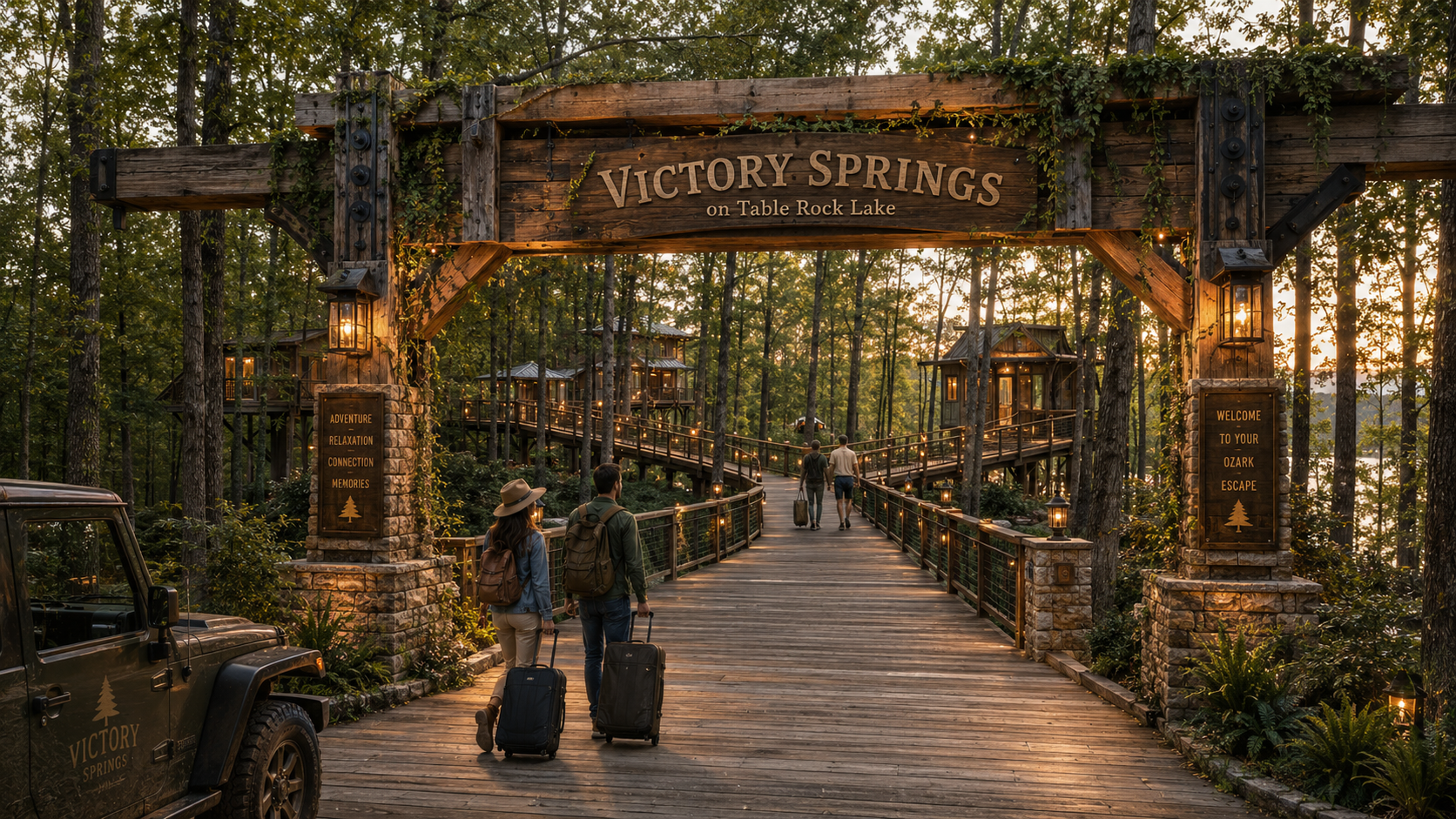
But I love what you did for us and that you shopped other places and you kind of, you built the model based on what our development was going to be, but you plugged that into these rates. So it was like, okay, so you know, if Superman wore the Flash's costume, how fast would he run? You know what I mean? And it was kind of like that and it works. It really does, because we're using both historical data and sort of our best-case. So for a project like Victory Springs, where we're trying to create a consistent branded resort-like experience, I mean, we're not a resort, we're a short-term rental development. The only difference is that we're not selling the homes to individual homeowners.
Because what I have found over the years is that those developments deteriorate faster because you're reliant on your neighbor to paint the house and fix up their deck at the same level of standard that you are. So, you know, uniformity in a development creates a lot of value. So and I don't think an HOA has really succeeded in doing the maintenance and selling the individual properties to individual owners and doing all of the exterior maintenance because the HOA dues would be so high in that case, you would never sell a single unit. But what we did find is that it's kind of a race to the bottom. You sell 60 properties to 60 different individual owners. It's a fragmented experience. I think the short-term rental world has matured.
It's getting out of its adolescent phase, which is I'm struggling with my identity as an asset class. I think real short-term rental owners, at least the good ones, I think Airbnb started the concept of this with their super host type, you know, classification. But you see, the hospitality industry has already figured out so many things so well. So right now, somebody goes to book a short-term rental and they're looking at, let's say, 10 different properties. They've got to talk to 10 different people. They have 10 different standards for the mattresses, 10 different standards for guest experience, 10 different standards for response times. So how do you as the consumer know where to go when it comes to a short-term rental?
I mean, you look at Chateau Cove, there's 60 properties you're looking at and they're all close together and they all look the same. So Victory Springs was designed to be different. It was designed so that you would have a singular experience. You would have one common place where you would go if you had any questions, concerns, or needed some extras. When you see that brand, whether it's Motel 6 or whether it's St. Regis, you expect something. I think that for the most part, short-term rental owners are, they need to wake up to the fact that branding matters because that's where the trust is built before the guest even arrives.
And that's one of the reasons why I know Victory Springs is going to succeed is because I believe people who are hungry for this product, they're hungry not just for a property to stay in, they're hungry for experiences. Those things you can do on campus that allow you to actually sit and enjoy your vacation and not feel like you're rushed. Rushed, Rushed, rushed. Where? You know that when I go to Victory Springs, I know my mattresses are going to be great. I know the customer service is going to be second to none. I know I'm going to get offered all these add ons even if I don't want it, they're there so I can have it if I want it. It's very easy for me to just say yes to this.
Jeramie Worley:
So for project like Victory Springs where we're trying to create that consistent branded resort-like experience instead of those fragmented one-off rentals, how does that maybe change our revenue strategy?
Luxury, Experience, and the Opportunity Ahead
Chris Hunter:
It can be what you want it to be. I've worked for branded properties before. I say, 'Looking at the data, this future date needs to be $100.' They go, 'Absolutely not. We will never go below $125.' I go, 'That's what you want? That's okay. Your room is going to sit empty.' They say, 'I'd rather it sit empty than sell it for less than $125.' Okay. If I predict the future correctly, you're going to be happy with that choice. That's fine by me. I'm your coach. It's your property. You tell me what you want it to be. In our research for Victory Springs rates, you and I saw Johnny Morris's rates at Big Cedar.
Eye-watering. I had to go back and redo the data because I'm like, 'I think I might have given you bad data,' because it was about 10x. I thought it was amazing—like he cracked the code. In my research for our talk, I realized Johnny Morris did not create the demand for that. He revealed it. He showed that there are people who will pay for that kind of experience. There are some trends here, especially in our area: nostalgia. People came here with their grandparents on vacation, and they want to do that for their kids. The guys at The Ozarker Lodge, Jeremy Wells and Dustin Myers, remodeled that property based on nostalgia. They are giving people the kind of experience they had when their grandparents brought them here as kids. I think that's so cool.
They are hospitality branding experts. They own a hospitality branding company that teaches people how to do this, so they decided they should probably do it for themselves. Another trend we're seeing is luxury. I had some notes here. Nationally, the data tells a very clear story: in 2025, luxury hotel RevPAR grew 3%, while economy RevPAR fell 4.4%. People who have a little extra money—and if they want luxury, if they want a nicer experience—they can do that. They also want experiences, like you're alluding to. They love the nature of the Ozarks, the lakes, the fishing, and just the beauty of nature. It feels like a perfect storm.
Even with timing and rebounding coming in upcoming years that this is going to be right on trend.
Jeramie Worley:
Well, you and I are going to have to do some work here soon because we're gonna have to figure out what that subjective value is for people to, you know, we've got Battleship Rock, we've got this place where people have been coming for generations that they can only get to by boat. And they go and they swim up to the cliffs, they climb up the cliffs and they jump off the cliffs. And now we've got exclusive walk-down access to these cliffs and it'll be interesting. I know the demand will be there because every time I go there's 12 to 15 boats out there and I know that people will want exclusive walk down access to those. How do we price that? We'll, we'll figure that out.
My overall feeling about this sort of philosophy whenever we have anything new, this has always worked for me in the past, actually works in pricing real estate too, is start off with value and let it sell out and let it create that demand. I think, what was it? Shoji Tabuchi's wife, Dorothy Tabuchi, that was her secret strategy that when all these buses would call the first year even though they weren't sold out, she would tell every single one of them, we're sold out, we're sold out. So they would book them for the next year. You know, I'll sell you a block of 25 seats for next year. We're sold out already. And it's that exclusivity and that scarcity that comes, that creates demand.
So we're actually coming up with a really cool welcome, you know, gift basket for our first 25 guests. You know, our first—our premier—guests. And we've got a, you know, a pretty cool party. We're planning for our investors as well. So I'm really excited about it and I really aPPReciate the time that we've spent together because you've really helped me understand how to manage this property better. I'm very thankful to have you on the team. I know we're all going to succeed with your additional brain power. So how do people get a hold of you if they wanted to hire you or consult with you for their own hospitality project or their hotel or short-term rental? How do they get a hold of you, Chris?
How to Connect with Chris Hunter
Chris Hunter:
You can find me at my basic website—I call it a business-card website—HotelRevenueMan.com. Same thing on YouTube if you want some free insight, a lot like what we gave here today. Hotel Revenue Man is the name of the channel. You can find me on LinkedIn. I love connecting with business people there. Just search Chris Hunter; I'm here in Branson.
Jeramie Worley:
Okay. Is there any, maybe any pressing thing that you wanted to say that you didn't get a chance to say anything that you're seeing or just any last minute things or do you feel like we covered everything pretty well?
Chris Hunter:
I feel like we covered it pretty well. Through my research getting ready for this conversation, I saw that the stars seem to be aligning, and the timing is good to capitalize on a unique opportunity. I'm pretty excited to look back at this conversation in years to come and tell people, 'You see this beautiful property over here? You see it always coming across social media?' I'm like, 'Oh yeah—let me show you something. We were there in the beginning.' I'm a dreamer like that, though.
Jeramie Worley:
Cool. Well, we're dreamers and we're doers because it's happening. So thanks for sharing some of your wisdom with everybody today and thanks for being on the team, Chris. It's always good to have.
Chris Hunter:
Yeah, thanks for including me. I had a blast.
Jeramie Worley:
You bet. Okay, there is our episode.
Connect with Chris Hunter / Hotel Revenue Man
Chris Hunter shares revenue-management insights for hotels and vacation-rental operators through Hotel Revenue Man. Learn more at https://hotelrevenueman.com/ and connect with him on LinkedIn at https://www.linkedin.com/in/chris-hunter-1a806963/.
Victory Springs is the hospitality development Jeramie and Chris discuss in the episode, including how real market-rate shopping, booking behavior, consistent standards, and brand positioning can inform revenue modeling. Learn more at https://www.victorysprings.com/ and follow updates at https://www.facebook.com/VictorySpringsTRL
Listen to Cocktails & Dreams
youtu.be/eTQpvm6XP3s?si=R372cVFLN6AvcEtc
https://open.spotify.com/show/2oWeHLsHQVSJJjU9GtRBBK?si=2786c2632b8a407f
https://podcasts.apple.com/us/podcast/cocktails-dreams-real-estate-podcast/id1632712936
About Cocktails & Dreams
Cocktails & Dreams Real Estate Podcast with Jeramie Worley is a long-form conversation about real estate, development, investing, hospitality, entrepreneurship, and the people building in those worlds. Episodes focus on practical experience, operating lessons, market insight, and the decisions behind real projects.