Preserving Battleship Rock: Why We Are Choosing a Slower Way to Move Rock at Victory Springs
Developing around Table Rock Lake means dealing with rock.
That is part of the Ozarks.
If you have spent any time building, digging, trenching, or cutting roads in this region, you already know the land does not always cooperate. There is rock under the soil, rock in the hillsides, rock in the trenches, rock where you want roads, rock where you want utilities, and rock exactly where the plan says something needs to go.
So when people talk about development near Battleship Rock, one of the real questions is not whether rock has to be moved.
It does.
The question is how.
In the Table Rock Lake area, blasting has been a common way to move rock because it is fast and efficient. It can help crews break through hard material, create roadbeds, cut utility paths, and make the land easier to shape construction.
There are times when blasting may be necessary on difficult sites. I am not pretending otherwise.
But blasting also comes with trade-offs.
It is loud. It is disruptive. It creates vibration. It can create dust. It can loosen and fracture rock quickly, but it can also force a bigger construction footprint than a more surgical approach.
And on a property like Victory Springs, where the trees, the slope, the rock, the lake, and the natural setting are the entire reason the development exists, the construction method matters.
So far we have not had to blast at Victory Springs.
And we plan to avoid it where we reasonably can.
That does not mean the work is easy. It means we are choosing a slower and more deliberate way to move through the property.
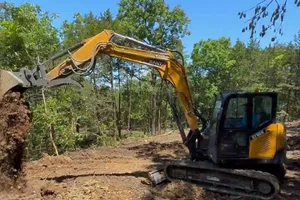
Instead of blasting rock apart, we have been working to break and move rock mechanically with equipment where possible.
That may sound like a small distinction, but on the land, it is not small.
A machine can work in a more controlled area.
A machine can break rock where the work is needed.
A machine can allow crews to move more carefully around trees, slopes, and natural features.
The result may still be a road, a trench, a pad, or a utility path.
But the process gives us a better chance to keep more of what made the property worth protecting in the first place.
More trees.
More shade.
More natural screening.
More habitat.
More birds.
More of the sound and feeling people actually come to the Ozarks to experience.
That is not some soft, sentimental idea. It is part of the development strategy.
When you preserve more trees, you preserve more than a look.
You preserve temperature.
You preserve privacy.
You preserve wildlife corridors.
You preserve the feeling of being tucked into nature instead of exposed on a scraped hillside.
You preserve the soundscape.
That word may sound fancy, but the idea is simple.
A place sounds different when the trees are still there.
You hear birds.
You hear wind moving through leaves.
You hear insects at night.
You hear the lake differently.
You feel the difference before you even know why.
That is part of what we want guests to experience at Victory Springs.
We are not trying to build a development where someone pulls up and says, "Well, this used to be pretty."
We want people to arrive and feel like the development was placed into the land carefully.
That is the difference between using the Ozarks as scenery and actually respecting the Ozarks as the main attraction.
Battleship Rock is not valuable because it is convenient.
It is valuable because it is dramatic, natural, rugged, and memorable.
The cliffs, the trees, the lake, the elevation, the view, and the approach all work together.
If we erase too much of that, we defeat the purpose.
That is why we are trying to be careful.
Careful does not mean doing nothing.
Careful means doing the work with more thought.
Roads still have to be cut.
Utilities still have to be installed and maintained.
Construction still has to move forward.
But there is a big difference between clearing everything because it is easier and working around the land because the land is worth the extra effort.
That is the philosophy behind Victory Springs.
The trees are not in the way of the project.
The trees are part of the project.
The rock is not only an obstacle.
The rock is part of the story.
The birds are not background noise.
They are part of the experience.
When someone is sitting on a deck in the morning with coffee, listening to the birds in the trees and looking toward Table Rock Lake, that is not an accident. That is the result of choices made long before the guest arrived.
Some of these choices are not glamorous.
They happen in the dirt.
They happen with equipment.
They happen when you decide not to take the fastest path because the fastest path may damage the thing you are trying to create.
That is the kind of development we are trying to do.
Not perfect.
Not pretending there is no impact.
Development has impact.
But responsible development asks whether the impact can be reduced, whether the land can be respected, and whether the final result can still feel connected to the place that came before it.
That is why the no-blasting approach matters to us.
It is not a marketing line.
It is a practical decision that reflects a larger belief.
Battleship Rock should not become another clear-cut hillside with a view.
It should remain a place where people feel the Ozarks around them.
A place where families can walk toward the water.
A place where guests can hear birds instead of only traffic and machinery.
A place where the trees still frame the experience.
A place where the rock, the bluff, and the lake are treated like assets, not inconveniences.
That is harder.
It takes more patience.
It may irritate a few people who would rather move faster.
But we believe it is worth it.
Because Victory Springs is not being built around the idea that nature is something to remove and replace later with landscaping.
Nature is the reason this place matters.
And if we are going to say we care about preserving Battleship Rock, then it has to show up in the way we do work.
So far, that has meant moving rock the slower way.
The more careful way.
The way that gives us a better chance to keep the trees, the birds, the shade, the sound, and the feeling of the land intact.
That is the plan.
And that is the standard we are working toward.
There is also growing research showing that natural soundscapes are not merely pleasant background noise. A 2022 study published in Scientific Reports found positive associations between seeing or hearing birds and mental wellbeing in real-world settings. That matters to us because preserving more trees means preserving more habitat, and preserving more habitat means guests have a better chance to experience the sights and sounds that make the Ozarks feel alive.