Maybe the Best Family Vacation Includes a Little Time Away From Your Family
There is a sign I have seen at Bob Evans that says, "Treat strangers like friends and friends like family." My wife and I have always added our own line to it: and family like strangers. It is obviously a joke. We love our family. That is precisely why the joke works.
Anyone who has traveled with a large family understands that love does not create identical preferences. Grandma and Grandpa do not necessarily want to experience the grandchildren at the same speed Mom and Dad do. A teenager does not want the same afternoon as a seven-year-old. One couple wants to hike. Another wants coffee. Somebody wants to fish. Somebody wants an hour where no one asks them a question.
And somehow we have created an idea that a successful family vacation means everybody should do the same thing together all day. I am not convinced.
A recent MSN story featuring Victory Springs put the idea nicely when it described families as groups that gather and separate. I think that is a more realistic model for multigenerational hospitality than simply building one giant room and calling it family-friendly.
The travel industry is seeing more permutations of the family trip as well. Hilton's 2026 global travel research reports growing interest in three-generation travel, grandparent-and-grandchild trips, and parents traveling one-on-one with individual children. In the same research, families expressed a strong desire for shared play and experiences, but the structure of the travel party itself is becoming less uniform.
That tells me the future of family hospitality is not simply about accommodating more people. It is about accommodating more relationships.
A grandparent relates to a child differently than a parent does. Adult siblings have their own rhythms. Couples need moments together inside the larger family trip. Children need some independence. Older travelers may need easier routes, comfortable places to sit, and a pace that does not require them to choose between keeping up and opting out.
This is why we are exploring what multigenerational space should actually look like at Victory Springs.
Some of the industry's larger brands are already experimenting with the physical side of that problem. Hilton highlights connected-room configurations and flexible accommodations for extended groups, while TUI's family hotel analysis points to separate sleeping areas, quieter adult spaces, and family layouts that allow different parts of the group to function without being stacked on top of one another.
Those are useful examples, but I think the Ozarks gives us another tool that is even more adaptable. Nature may be the best multigenerational space we have.
A trail does not require everyone to use it the same way. One person walks farther. Another sits near the beginning. A child stops every twenty feet because a bug has become the most important event of the day. Someone fishes. Someone reads. Someone stares at the water. They can all occupy the same landscape without having to share the same activity.
That flexibility is difficult to reproduce inside a programmed attraction.
The National Park Service encourages outdoor exploration as a family activity partly because natural settings support so many different forms of engagement, from walking and biking to simply exploring. Its family outdoor guidance is refreshingly simple: the outdoors gives people room to discover their own activity.
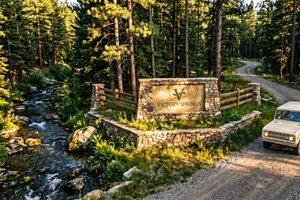
That is one reason the land around Victory Springs is so central to our thinking. Table Rock Lake, the terrain, the trees and the outdoor spaces are not merely scenery behind the accommodations. They can become the connective tissue between generations.
If Grandpa wants to sit in a comfortable place and watch the grandchildren do something ridiculous nearby, he is participating. If two adults take a walk while the rest of the family stays behind, they are still part of the trip. If the kids disappear into an outdoor space for a while and return hungry and filthy, that may be a successful afternoon.
The design challenge is to create enough shared gravity that the family naturally comes back together.
A large table can do that. A fire can do that. Food can do that. A view can do that. A comfortable outdoor gathering place can do that. The point is not to force proximity every minute. The point is to make reunion easy.
There is a paradox here that I think hospitality sometimes misses: privacy can improve togetherness. When people are allowed to retreat, they are more likely to return voluntarily. When every interaction is mandatory, even people we love can begin to feel like coworkers at a mandatory retreat.
Our goal at Victory Springs is not to engineer family harmony. No developer has that kind of power, and if someone claims they do, I would like to meet their relatives.
What we can do is think more carefully about the environments families occupy. We can build places where different generations can move at different speeds, find different levels of activity, and still share the same larger experience. Maybe the best family vacation includes a little time away from your family, not because you love them less, but because everybody deserves the chance to come back to the table because they want to be there.