Maybe Families Don't Need More to Do. Maybe They Need More Time Together.
For years, when our family could get there, we returned to Sanibel Island in Florida. The hurricane in Sept 2022 interrupted that tradition for a while, sadly, but the resilient locals rebuilt, and I was thankful. Some of my favorite family memories were formed there, and it happened before my little kids understood that doing less could actually become the point of the trip.
The first time we took them to the beach, we planned to stay for five days. We are a family full of redheads, so five consecutive beach days should probably qualify as a dermatological endurance event. On the first morning, everyone was excited. We were going to the beach.
The second morning, the kids asked, "What are we doing today?" I told them we were going to the beach. Fine. On the third morning the question came again. "What are we doing today?" Same answer. The beach. At some point one of them finally said what all of them were thinking: "Again?" Yes. Again.
Something changed after they realized I was not hiding a theme park, excursion, or elaborate entertainment schedule from them. They stopped waiting for the next thing. They started digging into the thing they already had. They hunted for shells. They explored. They invented their own fun. We learned to play cards on those trips and eventually learned spades, which became part of the family vocabulary in a way no scheduled attraction ever could.
That memory came back to me while reading a recent MSN feature about changing family vacation preferences that included Victory Springs. The article made a simple observation: many of the best family trips are defined less by the length of the amenity list and more by how families spend time together. I think that idea deserves more attention than it usually gets.
Branson already knows how to entertain people. If a family wants shows, attractions, restaurants, golf, boating, shopping, or something unexpected to do, this market has built an extraordinary ecosystem around that desire. Table Rock Lake adds another world of recreation on top of it. Victory Springs does not need to pretend that entertainment is scarce here.
The more interesting question is what hospitality can provide that an entertainment destination cannot manufacture on command. Sometimes the answer is simply time.
Not empty time in the depressing sense. I mean enough unclaimed time for a family to settle into a place. Enough time for a child to stop asking what is next and start noticing the creek, the rocks, the birds, or the weird hollow tree twenty yards away. Enough time for adults to sit at a table after dinner because nobody has tickets for anything at 7:30.
The travel industry is starting to see similar behavior in its own data. In 2026, TUI reported from family booking and search data that parents often prioritize practical ease, family-friendly room layouts and low-friction experiences over flashy extras. Hilton's 2026 travel trends research found that families are actively seeking shared play and connection, with many parents also planning deliberate periods without screens.
None of that suggests families have suddenly become anti-fun. Quite the opposite. It suggests that people are becoming more selective about the kind of fun they want. A schedule can produce activity. It cannot guarantee connection.
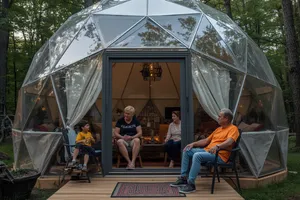
That distinction influences the way we think about Victory Springs near Table Rock Lake. We want the property to give people options, but we also want to resist the temptation to program every minute. The lake, the Ozark landscape, gathering spaces, accommodations, and the larger Branson destination can all participate in the trip without every hour becoming an assignment.
There is a phrase I keep coming back to in our development philosophy: designing from the guest experience backward. Cornell's hospitality programs teach experience design as a systematic discipline, beginning with an understanding of the guest rather than treating service as something added after the physical product is finished. Cornell describes guest-experience design as the alignment of customer needs, brand, design, and process. That is remarkably close to what we are trying to do in physical form.
If the desired experience is family connection, the answer is not automatically another amenity. Sometimes the better answer is a porch positioned where people want to stay awhile. A table that invites a card game. Enough separation that one part of the family can be noisy while another part is quiet. A natural setting interesting enough that children find their own agenda.
One of the mistakes adults make is assuming that a good memory has to be impressive while it is happening. Some of the memories that stay with us are almost embarrassingly ordinary. We remember a hand of cards. A stupid joke. The meal everybody helped make. The afternoon when nothing was planned and somehow everyone ended up together.
My kids probably do not remember every restaurant we visited on Sanibel. I am not sure I do either. But I remember the transition during those five beach days. At first, they wanted to know what we were going to do. By the end, they had stopped asking. They had learned how to be there.
That may be one of the most useful things a family destination can offer. Not constant stimulation. Not a competitive list of things to check off. Just enough beauty, comfort, and possibility that a family has permission to stop moving long enough to find each other again.